What Does Quantum Advantage Mean vs Quantum Supremacy?
Introduction
One of the most common questions in quantum computing is What is the difference between “quantum supremacy” and “quantum advantage”? The two terms are often used interchangeably in popular media, but they describe different milestones in the evolution of quantum computing.
A simple way to remember the distinction is:
- Quantum Supremacy – A quantum computer performs a specific task that is practically impossible for a classical computer.
- Quantum Advantage – A quantum computer performs a useful real-world task better, faster, or cheaper than a classical computer.
Why Do We Need These Terms?
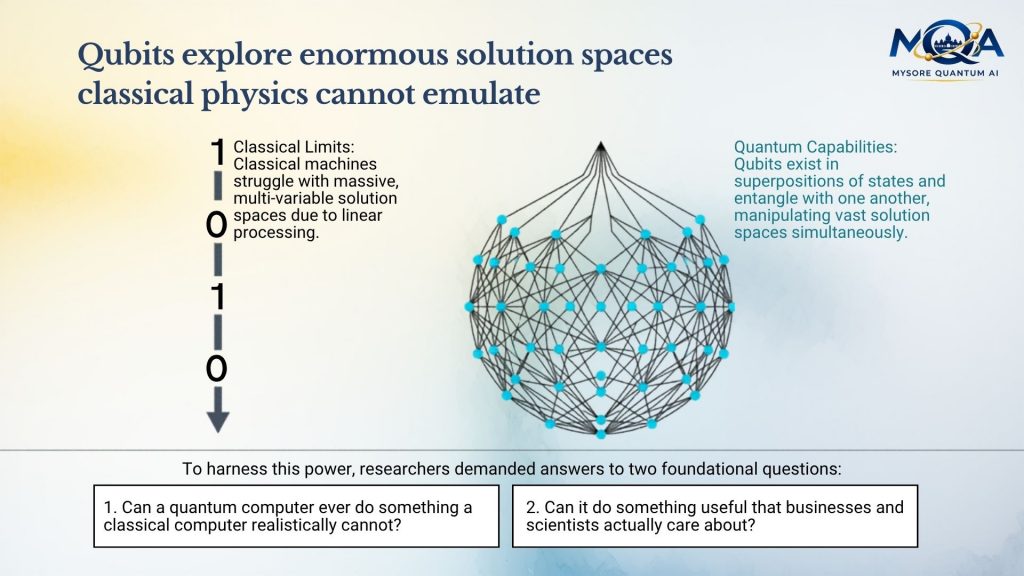
Quantum computers use qubits, which can exist in superpositions of states and can become entangled with one another. These quantum properties allow certain computations to explore enormous solution spaces in ways that classical machines struggle to emulate. However, merely building a quantum computer is not enough.
Researchers wanted answers to two questions:
- Can a quantum computer ever do something a classical computer realistically cannot?
- Can it do something useful that businesses and scientists actually care about?
The first question led to quantum supremacy and the second led to quantum advantage.
1. Quantum Supremacy: The Academic Proof of Concept
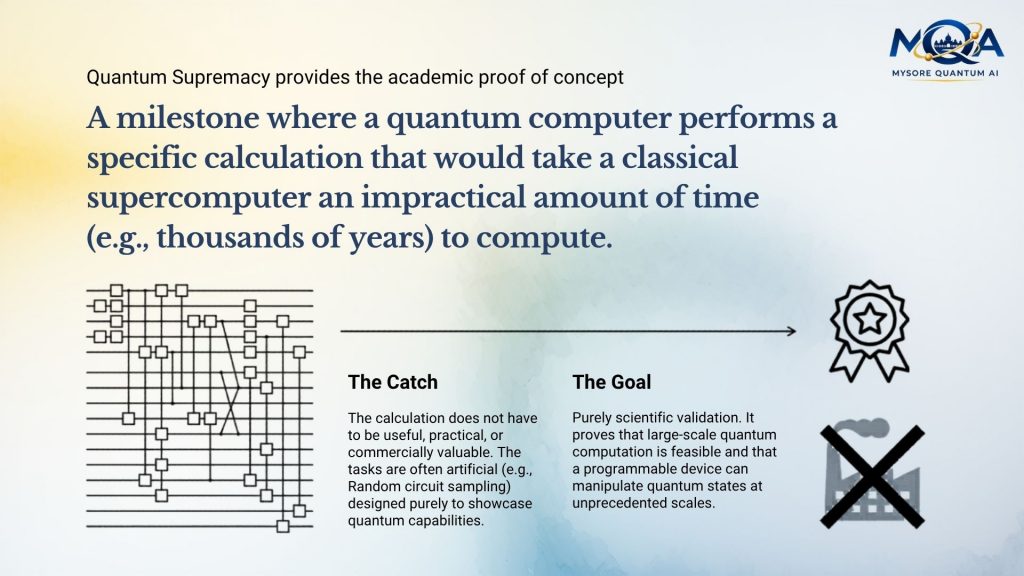
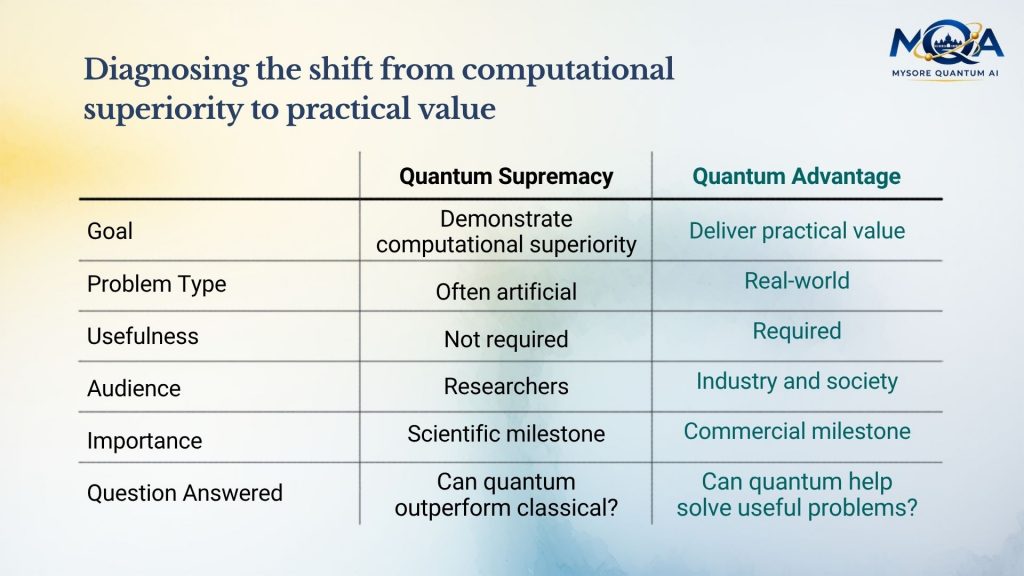
Quantum Supremacy is the point at which a quantum computer can perform a specific calculation that a classical supercomputer would take an impractical amount of time (think thousands of years) to compute.
- The Catch: The calculation does not have to be useful, practical, or commercially valuable.
- The Goal: Purely scientific validation. It proves that a programmable quantum device can manipulate quantum states at a scale that leaves classical physics in the dust.
In 2019, Google claimed this milestone with its 53-qubit Sycamore processor, using a highly specialized problem called Cross-Entropy Benchmarking. While the problem had no real-world application, it served its purpose: it proved the math works. Nevertheless, the experiment became a historic milestone because it demonstrated that quantum hardware was beginning to compete with the best classical methods.
Important Characteristics of Quantum Supremacy – The task may be artificial
and the problem is often intentionally designed to showcase quantum capabilities.
Examples include:
- Random circuit sampling
- Boson sampling
- Specialized benchmarking tasks
These problems are usually not useful for business or industry.
The goal is proof, not utility – Supremacy asks: “Can a quantum machine outperform classical computation at all?” and It does not ask: “Does any application need this calculation?”
A scientific milestone – Supremacy is primarily important to physicists, computer scientists, and hardware developers because it demonstrates that large-scale quantum computation is feasible.
2. Quantum Advantage: The Real-World Game Changer
Quantum Advantage is achieved when a quantum computer can solve a useful, real-world problem significantly faster, cheaper, or more accurately than the best available classical supercomputer.
- The Key Difference: The focus shifts from abstract capability to practical utility.
- The Goal: Commercial and societal impact.
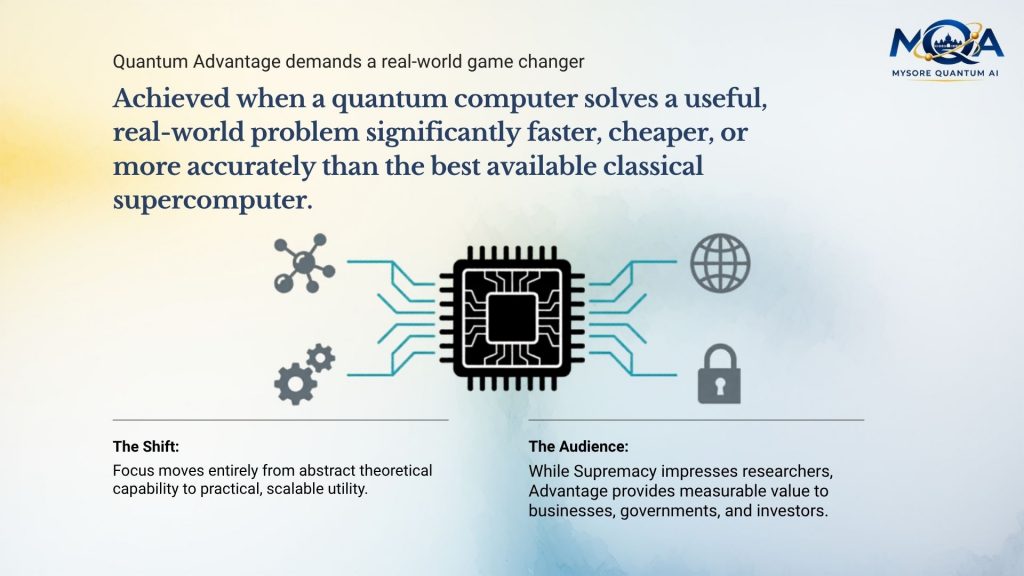
The Goal is utility – Quantum advantage answers: “Why should anyone use a quantum computer?” A supremacy demonstration may impress researchers.
An advantage demonstration attracts:
- Businesses
- Governments
- Scientists
- Investors
because it provides measurable value.
Comparing the Two
Why the Community Prefers “Quantum Advantage”
The term “quantum supremacy” generated controversy because the word “supremacy” carries social and historical connotations that many researchers found problematic.
As a result, much of the quantum computing community now prefers:
- Quantum Advantage
- Quantum Computational Advantage
These terms emphasize technological achievement without the controversial language.
Today, many papers and conferences increasingly use “quantum advantage” even when discussing performance milestones.

Where Might Quantum Advantage Appear?
Researchers are investigating quantum advantage in several domains.
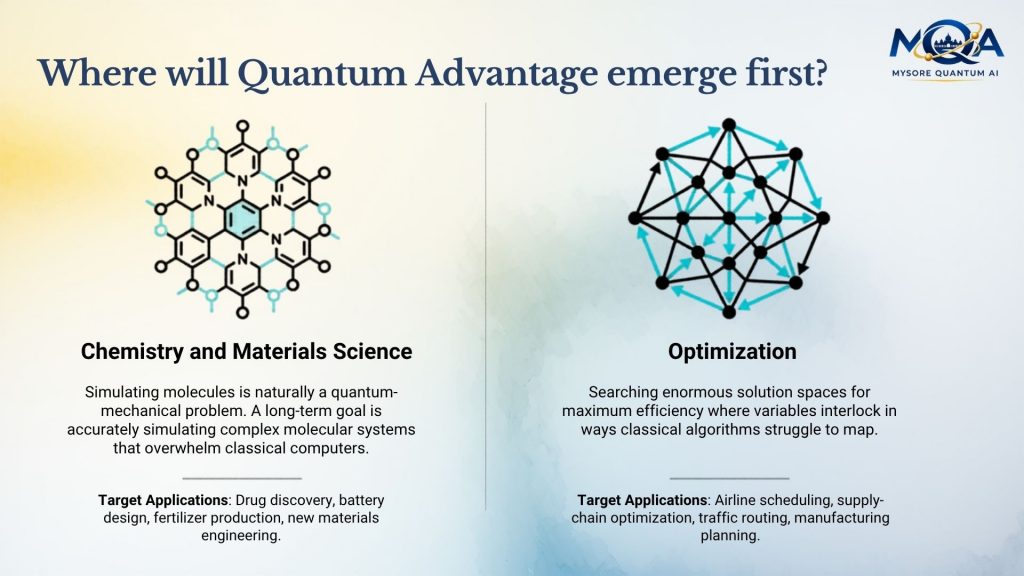
1. Chemistry and Materials Science
Simulating molecules is naturally a quantum-mechanical problem.
Potential applications include:
- Drug discovery
- Battery design
- Fertilizer production
- New materials
A long-term goal is accurately simulating complex molecular systems that overwhelm classical computers.
2. Optimization
Many industries must search enormous solution spaces.
Examples:
- Airline scheduling
- Supply-chain optimization
- Traffic routing
- Manufacturing planning
Quantum algorithms may eventually provide better solutions for some classes of optimization problems.
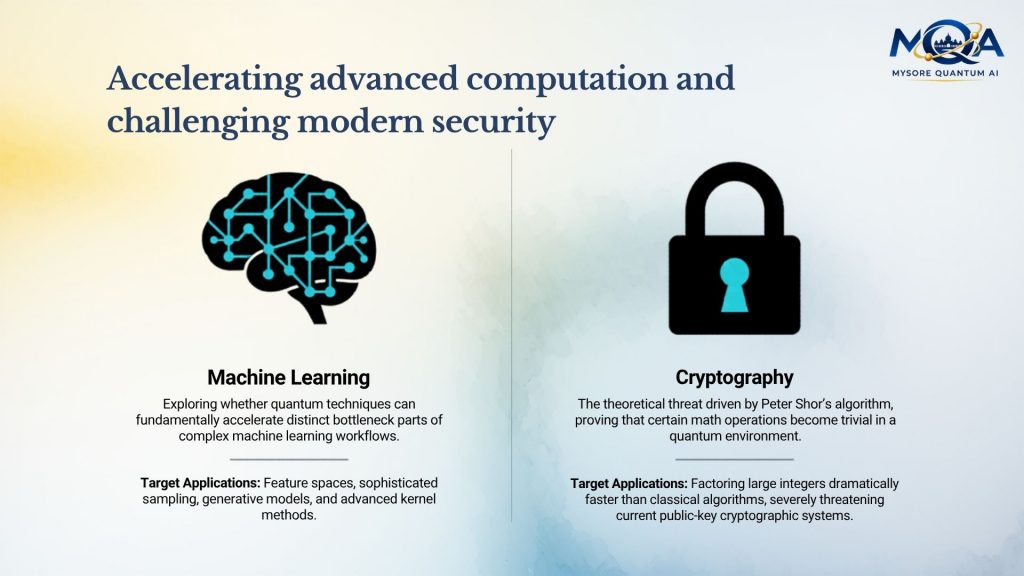
3. Machine Learning
Researchers are exploring whether quantum techniques can accelerate parts of machine learning workflows.
Potential areas include:
- Feature spaces
- Sampling
- Generative models
- Kernel methods
The extent of future advantages remains an active research question.
4. Cryptography
One of the most famous theoretical advantages comes from Peter Shor’s algorithm.
It shows that a sufficiently large fault-tolerant quantum computer could factor large integers dramatically faster than known classical algorithms.
This would threaten many current public-key cryptographic systems.
Have We Achieved Quantum Advantage Yet?
The answer is: In limited situations, perhaps. In a broadly useful and commercially transformative sense, not yet.
Researchers have reported examples where quantum processors outperform classical approaches for specialized problems.
However:
- The problems are often narrow.
- Classical algorithms continue improving.
- Quantum hardware remains noisy and limited.
Most experts believe that widespread, undeniable quantum advantage for major industrial applications is still a future milestone
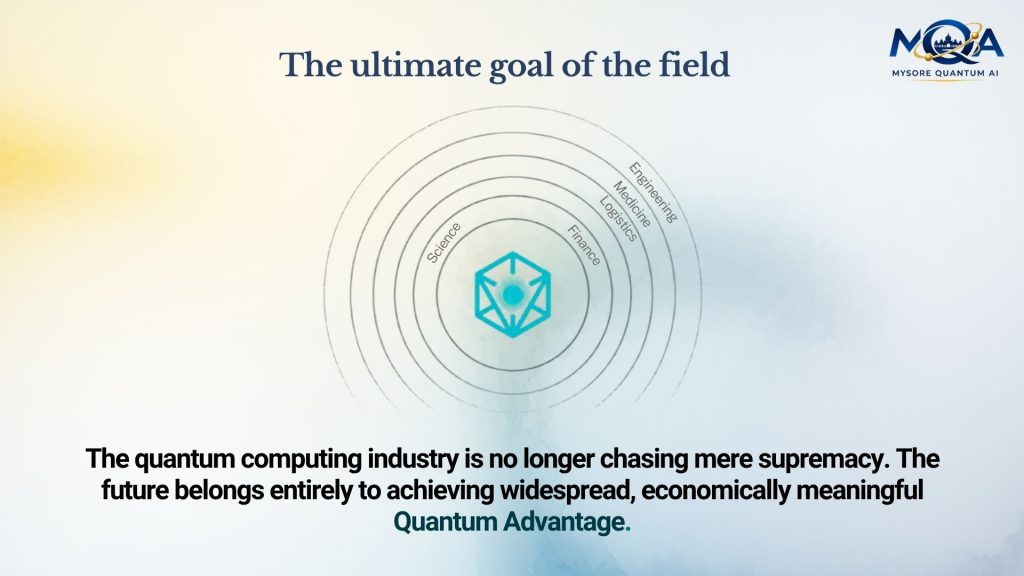
The ultimate goal of the field is not merely supremacy – it is achieving widespread, economically meaningful quantum advantage across science, engineering, medicine, logistics, finance, and beyond.