Quantum Fourier Transform – What it does
Demystifying the Quantum Fourier Transform (QFT)
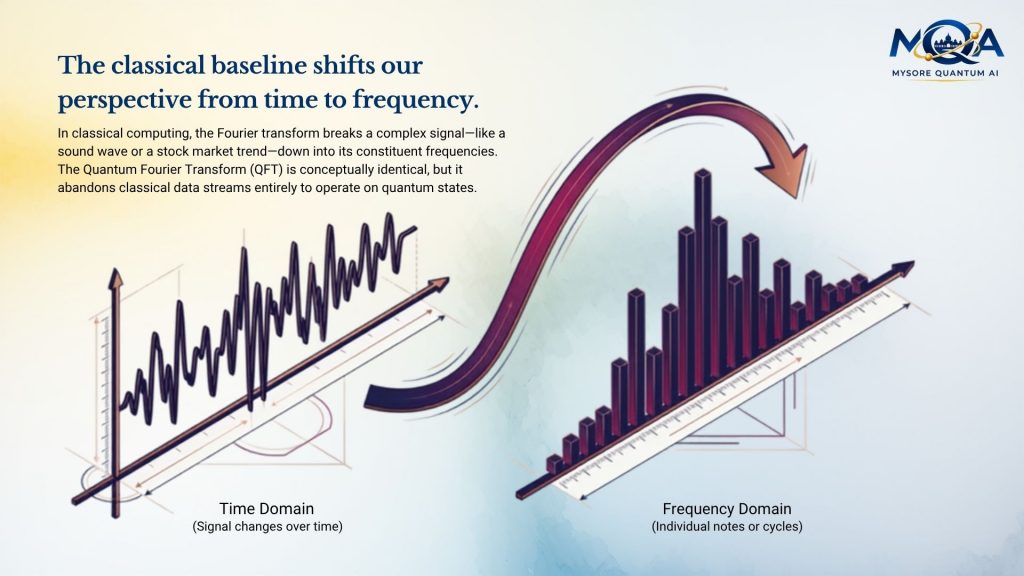
To understand what the Quantum Fourier Transform (QFT) does, it helps to start with its classical sibling, the Discrete Fourier Transform (DFT).
In the classical world, the Fourier transform takes a signal, like a sound wave or a stock market trend and breaks it down into its individual frequencies. It shifts your perspective from the time domain (how a signal changes over time) to the frequency domain (the individual notes or cycles that make up that signal).
The QFT does something conceptually identical, but it operates on quantum states instead of classical data streams.
What Does QFT Actually Do?
Mathematically, the QFT takes a quantum state and maps it to a new quantum state by altering its amplitudes. But intuitively, the best way to understand the QFT is through the lens of information encoding.
1. Shifting from Positions to Phases
In a quantum computer, we often encode information in the computational basis, meaning we look at whether our qubits are |0⟩ or |1⟩ .
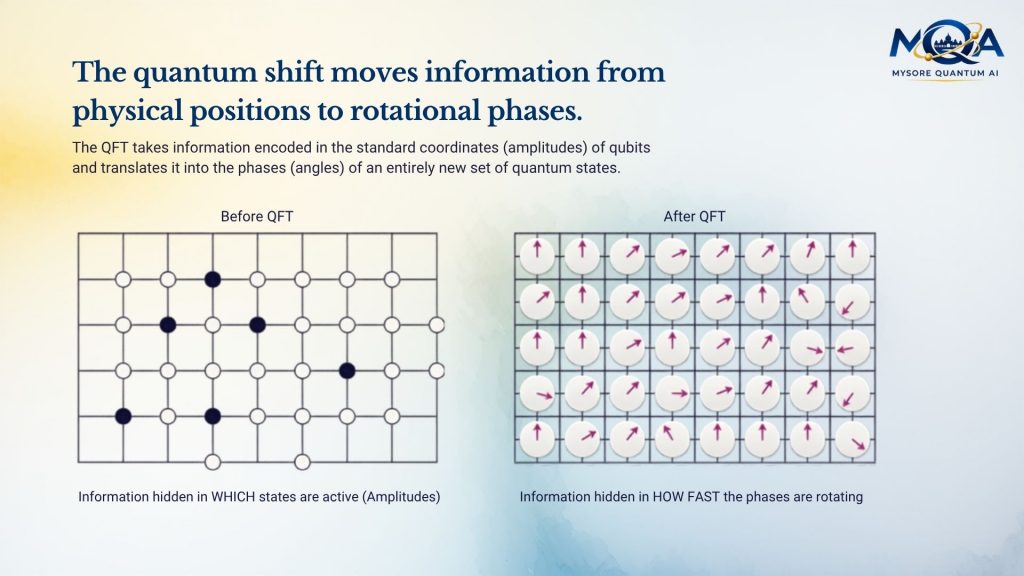
The QFT takes information encoded in the coordinates (amplitudes) of these standard states and translates it into the phases (angles) of a new set of states.
- Before QFT: The information is hidden in which computational states are active.
- After QFT: The information is hidden in how fast the phases of the states are rotating.
2. The Geometric View: Winding the Clock
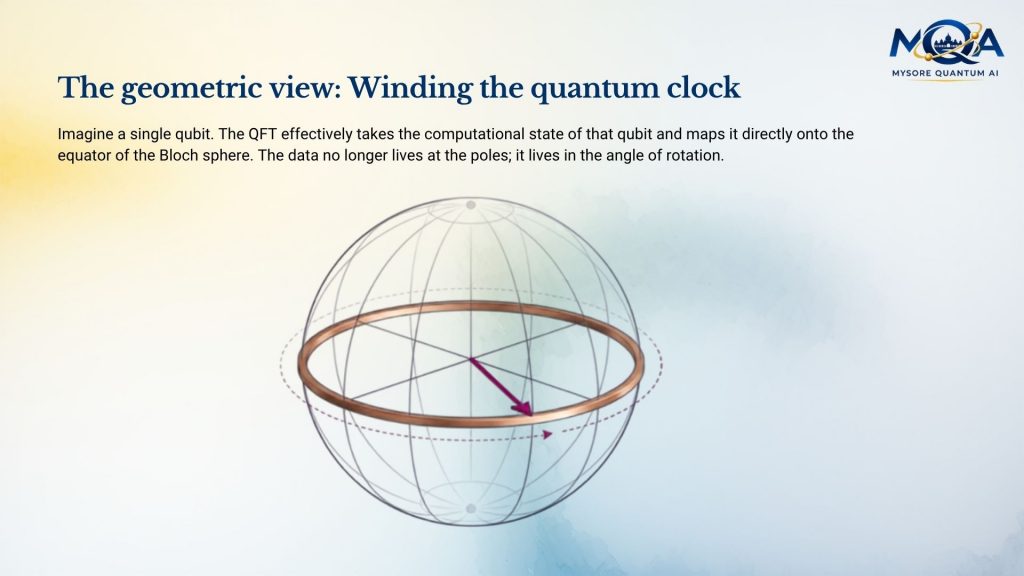
Imagine a single qubit. The QFT effectively takes the state of that qubit and maps it onto the equator of the Bloch sphere (the geometric representation of a qubit’s state space).
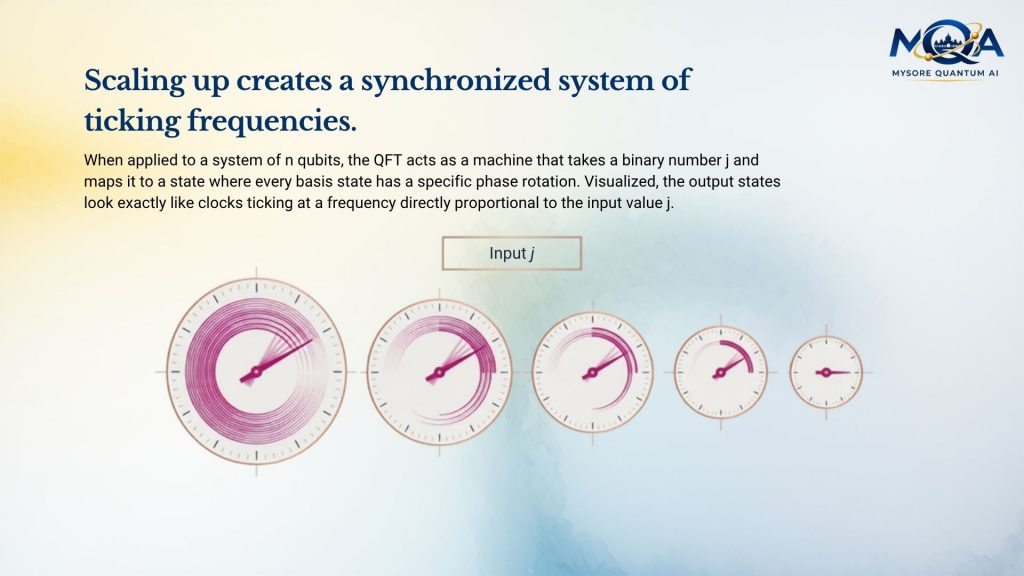
When we scale this up to n qubits, the QFT acts like a machine that takes a binary number j and maps it to a state where every basis state has a specific phase rotation. If you were to visualize the phases of the output states, they look like clocks ticking at a frequency directly proportional to the input value j.
If the input is a repeating pattern (a periodic state), the QFT concentrates the quantum waves, creating constructive interference at the exact frequency of that pattern and destructive interference everywhere else.
Why is QFT a Quantum Superpower?
If the QFT does the same thing as the classical Fourier transform, why is it such a massive breakthrough? It comes down to two major advantages: Speed and Parallelism.
Exponential Speedup
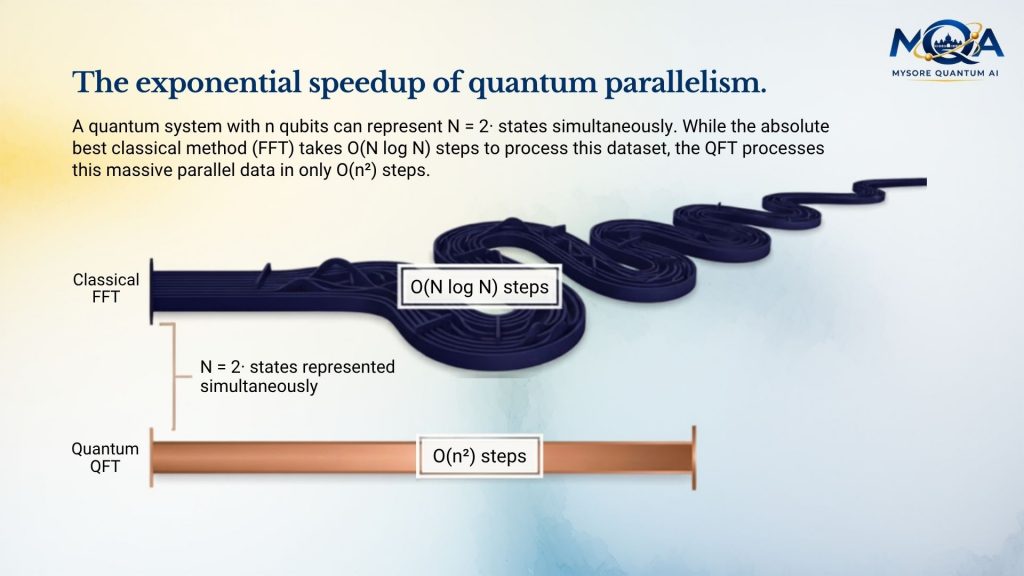
To compute the Fourier transform of a dataset of size N classically, the fastest method (the Fast Fourier Transform, or FFT) takes roughly 0 ( N log N ) steps.
Because a quantum system with n qubits can represent N = 2 n states simultaneously, the QFT can process this massive amount of data using only about 0 (n2) or 0((log N )2 )steps. This is an exponential speedup over the absolute best classical algorithms.
The Catch (and the Quantum Brilliance)
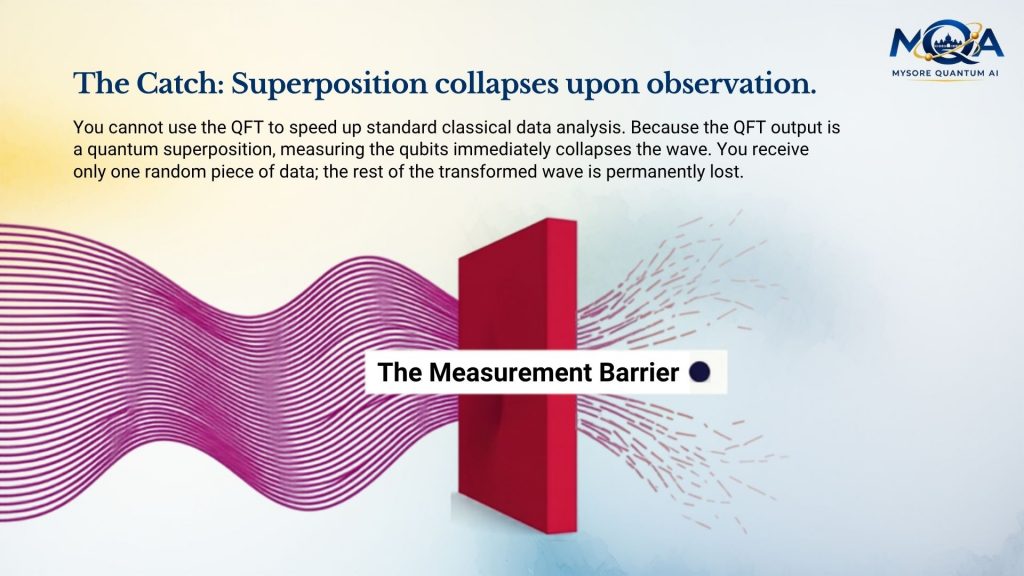
Here is the pedagogical twist: You cannot use the QFT to speed up standard classical data analysis. Why? Because the output of the QFT is a quantum superposition. If you measure the qubits immediately after running a QFT, the superposition collapses, and you only get one random piece of data back. You lose the rest of the transformed wave.
Therefore, the QFT isn’t used to look at a Fourier transform. Instead, it is used as a crucial sub-routine inside larger quantum algorithms. It manipulates the underlying probabilities so that the correct answer becomes highly likely to be measured at the very end of the program.
Where is it Used?
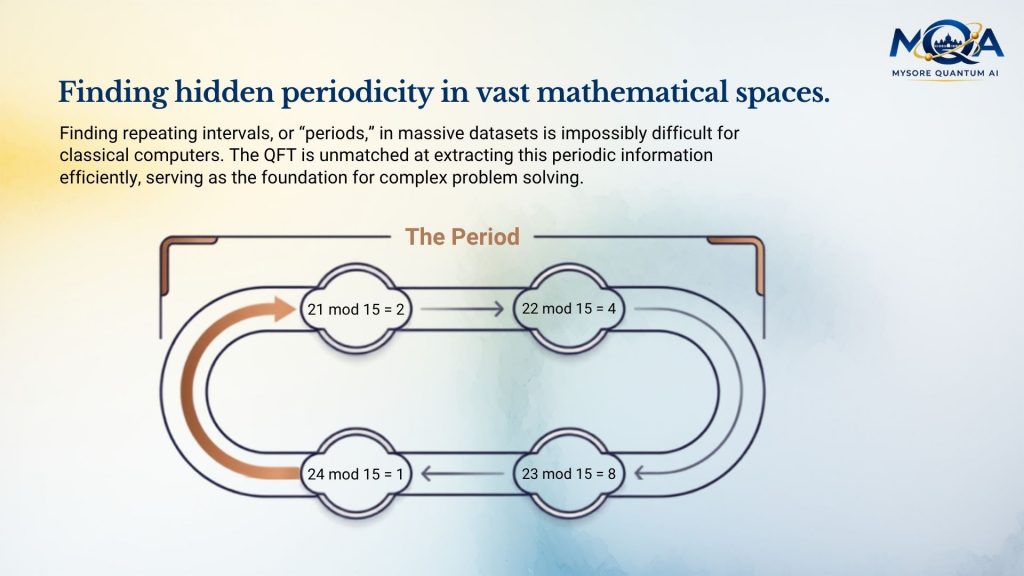
Because the QFT is unmatched at finding periodicity (hidden patterns and frequencies) across vast mathematical spaces. Many difficult mathematical problems contain repeating patterns.
For example
2¹ mod 15 = 2
2² mod 15 = 4
2³ mod 15 = 8
2⁴ mod 15 = 1
2⁵ mod 15 = 2
2⁶ mod 15 = 4
…
Notice that the values repeat. This repeating interval is called the period (or order).
Finding this period is difficult for classical computers. The QFT makes it possible for a quantum algorithm to extract this periodic information efficiently, it serves as the engine for the most famous quantum algorithms in existence:
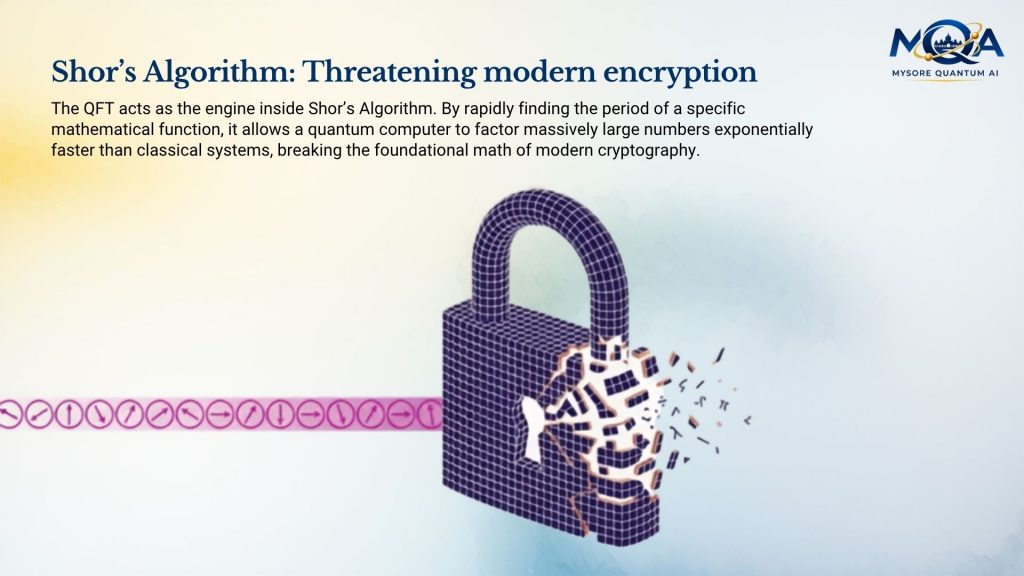
Shor’s Algorithm: The QFT is the engine that finds the period of a specific mathematical function, which allows a quantum computer to factor large numbers exponentially faster than classical computers, threatening modern encryption.
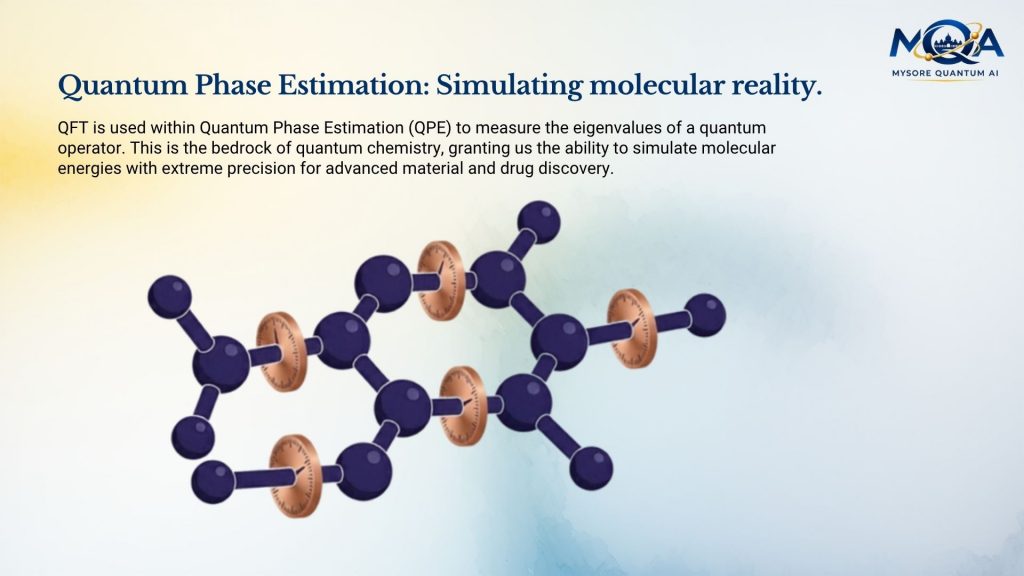
Quantum Phase Estimation (QPE): QFT is used to measure the eigenvalues of a quantum operator. This is foundational for quantum chemistry, allowing us to simulate molecular energies with extreme precision.
Summary in a Sentence
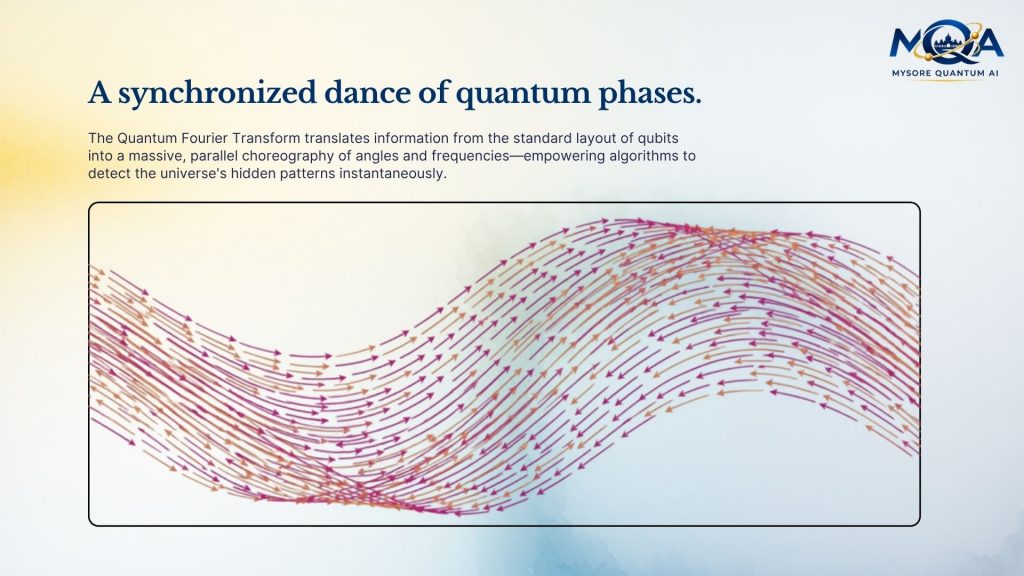
The Quantum Fourier Transform translates information from the standard layout of qubits into a synchronized dance of quantum phases, allowing quantum algorithms to detect hidden patterns and periodicities across an exponential amount of data instantaneously.