Measurement – Why Observing Collapses the State
If superposition gives many possibilities, and interference reshapes those possibilities, then measurement is the moment where possibility turns into reality.
This is where the quantum world finally meets the classical world.
The Core Idea: From Many Possibilities to One Outcome
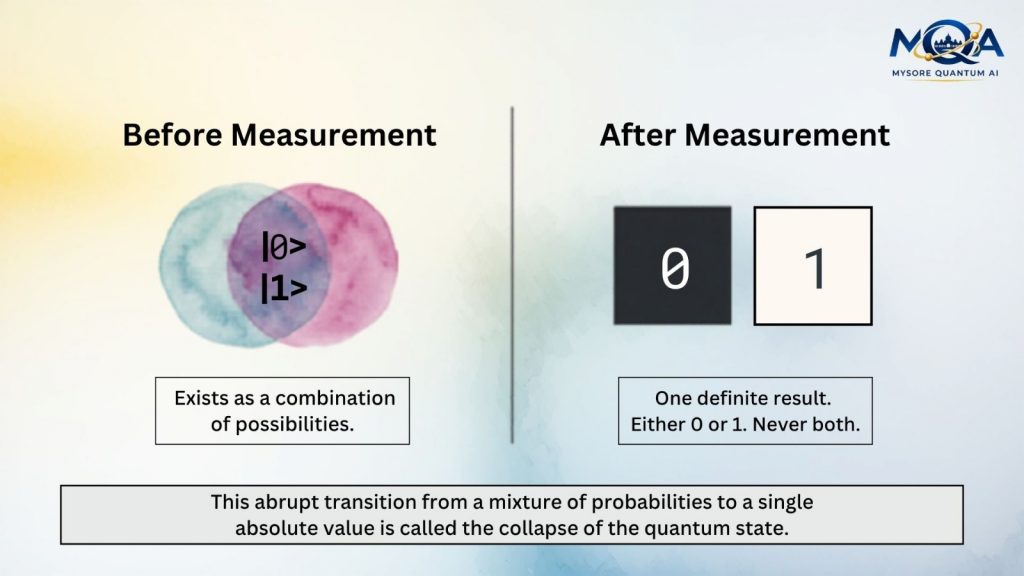
Before measurement, a qubit is not in a single state. It exists as a combination of possibilities.
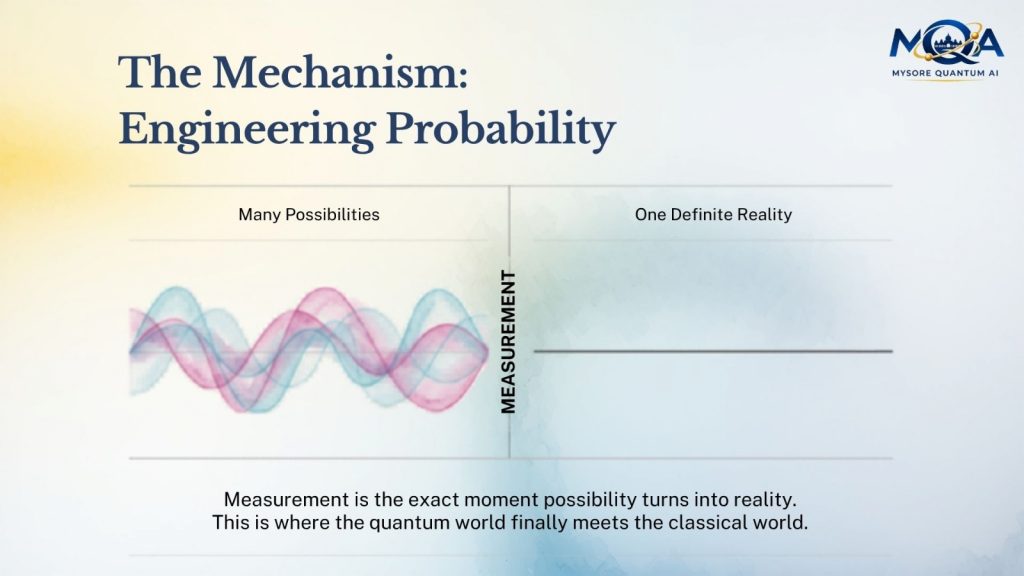
But the moment you measure it, you get one definite result.
- A qubit in a mix of |0⟩ and |1⟩
- After measurement it will be either 0 or 1, never both
This transition is what we call collapse of the quantum state.
Why Does Collapse Happen?
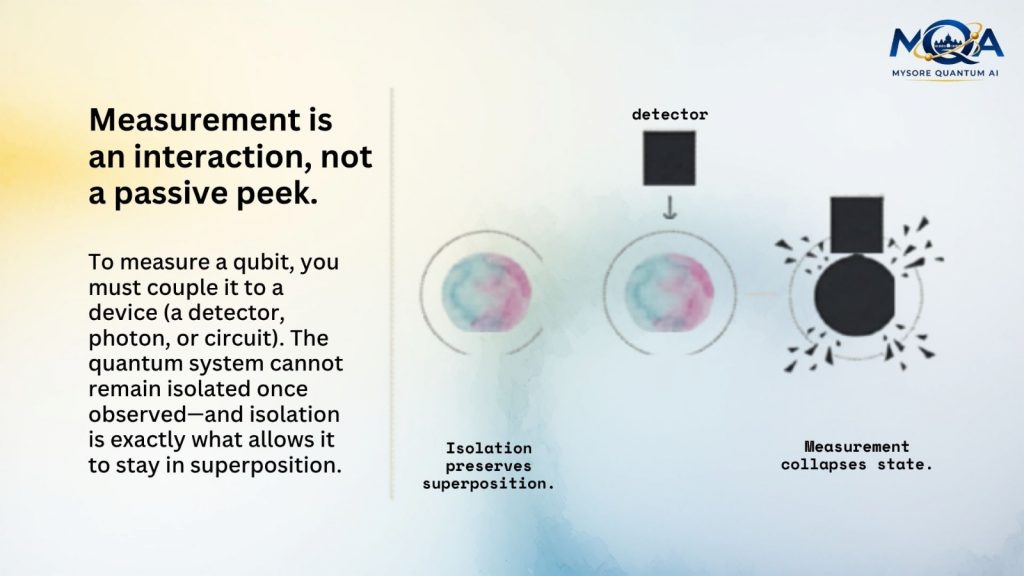
Measurement is not a passive peek into its state, It is an interaction.
To measure a qubit, you must:
- Couple it to a device (detector, photon, circuit, etc.)
- This interaction forces the system to choose an outcome
In simple terms:
The quantum system cannot remain isolated once you try to observe it.
And isolation is exactly what allowed it to stay in superposition.
A Simple Mental Model: The Blurry Coin
In the classical spinning coin analogy
- While spinning, it’s not clearly heads or tails
- The moment you stop it forces to a definite result
Quantum systems are similar but deeper:
- The blur is not due to motion or ignorance
- It is a real combination of possibilities
- Measurement is like grabbing the coin, forcing a definite face
What Actually Changes During Measurement
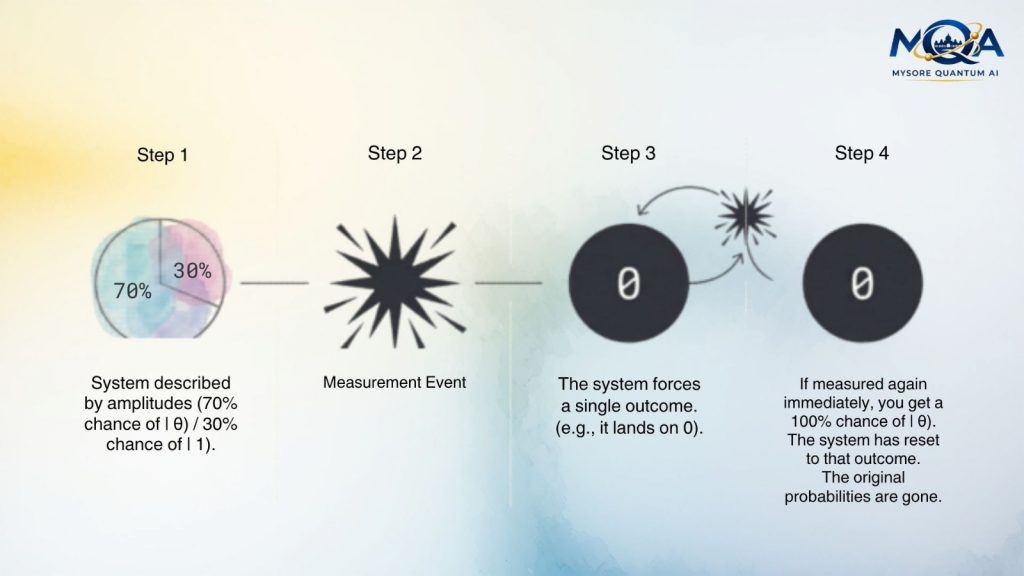
Before measurement:
- The system is described by amplitudes (possibilities)
After measurement:
- You get a single outcome
- The system resets to that outcome
Example:
If a qubit has:
- 70% chance of being |0⟩
- 30% chance of being |1⟩
After measurement:
- You get either 0 or 1
- If you measure again immediately, you get the same result
This is because the state has already collapsed.
Where People Get It Wrong
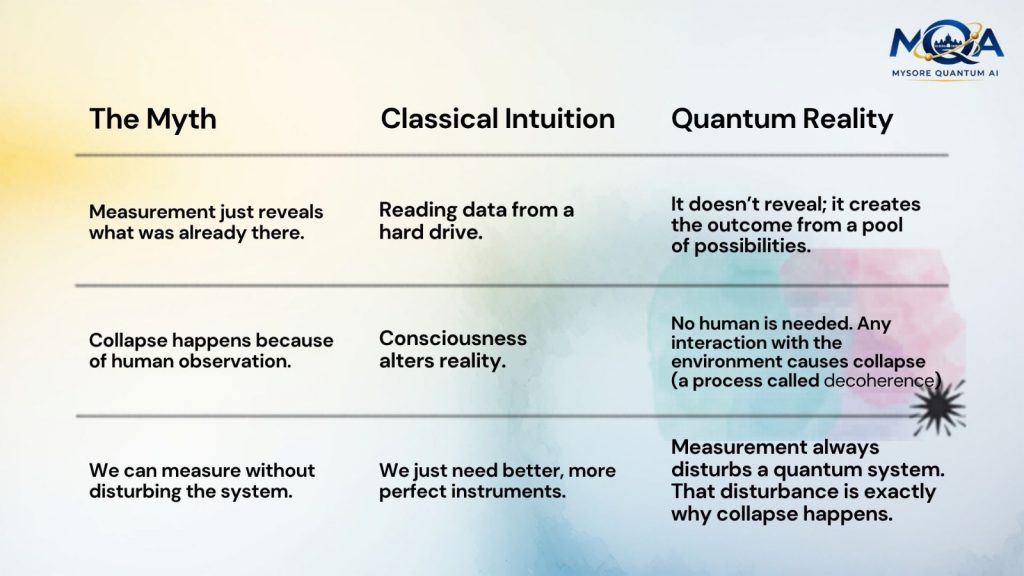
Myth 1: “Measurement just reveals what was already there”
Reality: It doesn’t reveal, it creates the outcome from possibilities.
Myth 2: “Collapse happens because of human observation”
Reality:
No human is needed. Any interaction with the environment can cause collapse.
This is called decoherence.
Myth 3: “We can measure without disturbing the system”
Reality:
Measurement always disturbs a quantum system. That disturbance is exactly why collapse happens.
Measurement and Probability: Not Random Chaos
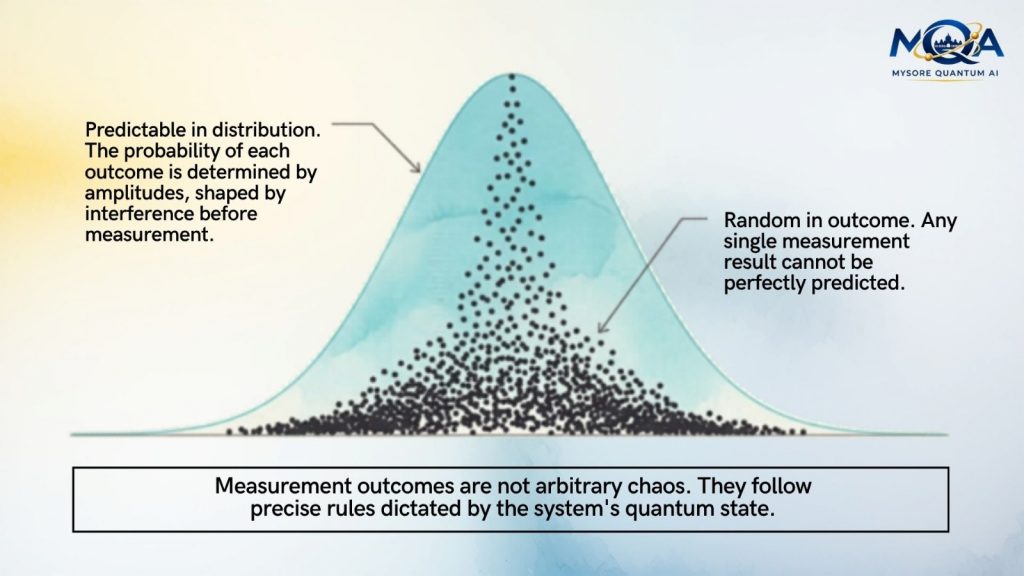
Measurement outcomes are not arbitrary.
They follow precise rules:
- The probability of each outcome is determined by the amplitudes
- These probabilities are shaped before measurement (through interference)
So measurement is:
- Random in outcome
- Predictable in distribution
Why Measurement Is So Important in Quantum Computing
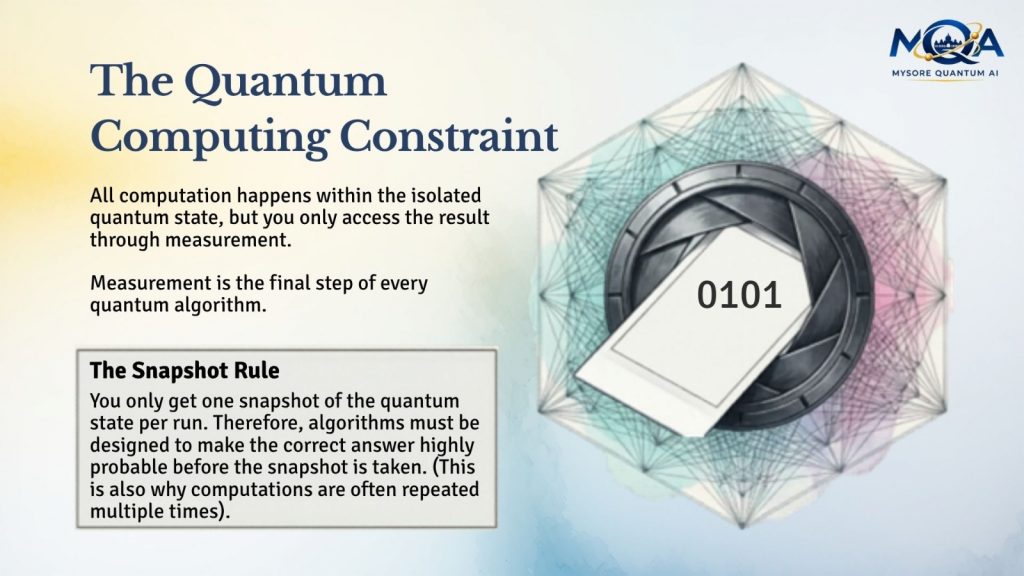
Measurement is the final step of every quantum algorithm.
- All the computation happens in the quantum state
- But you only access the result through measurement
This creates a constraint:
You only get one snapshot of the quantum state per run
That’s why:
- Algorithms are designed to make the correct answer highly probable
Sometimes we repeat the computation multiple times
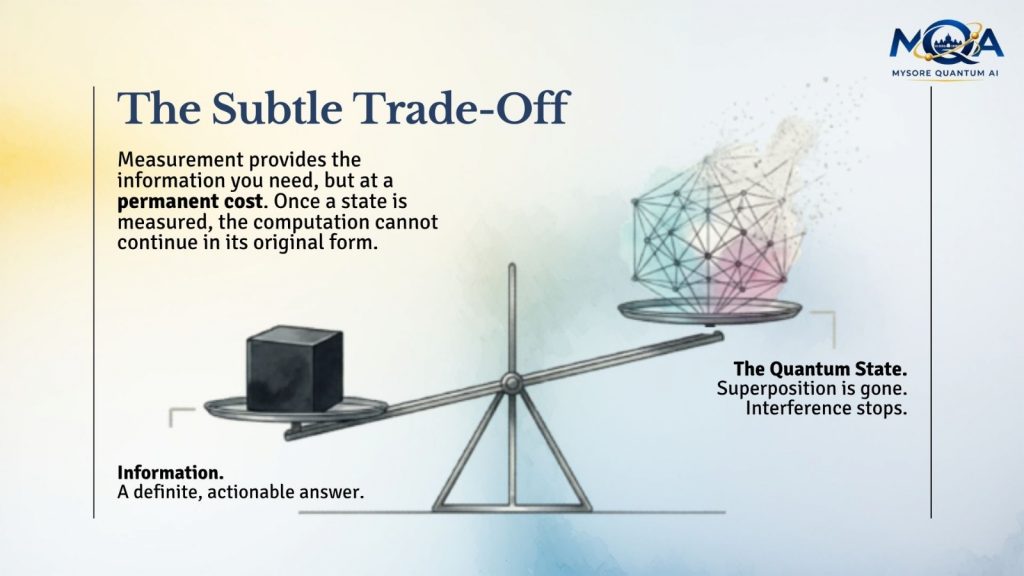
The Subtle Trade-Off
Measurement gives you information but at a cost, a definite answer is got losing the rich quantum state
Once measured,
- Superposition is gone
- Interference stops
- The computation cannot continue in its original form
Connecting the Big Picture
- Superposition, creates many possibilities
- Interference, reshapes those possibilities
- Measurement, extracts one outcome

Bottom Line
Measurement is not just observation, it is interaction that forces a quantum system into a definite state.
It:
- Converts possibility into reality
- Produces a single outcome from many
- Ends the quantum computation
In short:
Quantum systems can explore many answers, but measurement is the moment they must commit to one.