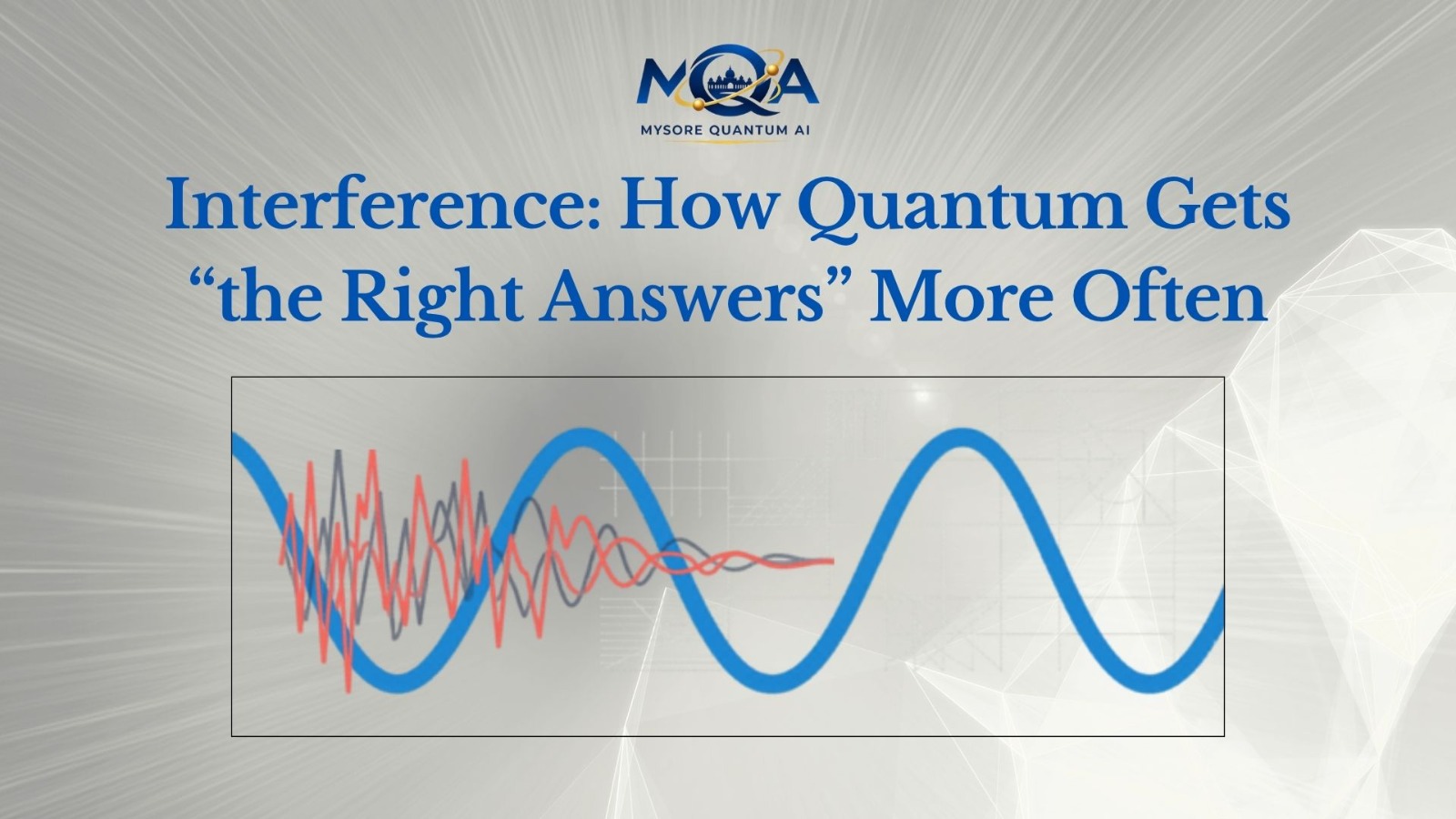
Interference – How Quantum Gets “the Right Answers” More Often
If superposition gives us many possible answers at once, and entanglement links qubits together, then interference is what actually picks out the useful answers.
Without interference, a quantum computer would just be a fancy random generator.


The Core Idea: Amplitudes Can Add and Cancel
In classical probability, chances only add up.
But in quantum systems, we deal with amplitudes (not probabilities), and amplitudes can:
- Add (constructive interference) makes an outcome more likely
- Cancel (destructive interference) makes an outcome less likely or even impossible
This is the key difference.
Think of it like waves:
Two waves align to form a bigger wave and when they oppose, they flatten each other
Quantum states behave the same way.

A Simple Mental Model: The Maze with Many Paths
Imagine a maze with multiple paths leading to different exits.
- Each path contributes a wave toward an exit.
- Some paths reinforce each other – bright (high probability) exits
- Some paths cancel out – dark (low probability) exits
A classical computer:
- Tries paths one by one
A quantum computer:
- Explores all paths at once
- Then uses interference to cancel wrong paths and boost correct ones

What Interference Actually Does
Let’s say you have 4 possible answers:
|00⟩, |01⟩, |10⟩, |11⟩
Initially (after superposition), all are equally likely.
Interference changes this by:
• Reducing amplitudes of wrong answers
• Increasing amplitude of the correct answer
So after processing:
• Wrong answers have near zero probability
• Correct answer has high probability
This is why quantum algorithms don’t just “guess”, they engineer probability.

The Mechanism (Without the Math Overload)
Here’s the intuition:
- Start in superposition – All possibilities exist
- Apply transformations (quantum gates) – These act like wave shapers
- Interference happens – Paths combine, reinforce, or cancel
- Measure – You are more likely to see the correct answer

A More Accurate Intuition: Noise-Cancelling Headphones
Think of noise-cancelling headphones:
- They detect unwanted noise
- Generate an opposite wave
- The two waves cancels
Quantum interference does something similar:
- “Wrong answers” get opposite phases
- They cancel themselves out
- Only the “right answers” remain strong
Where People Get It Wrong
Myth 1: “Quantum computers try all answers and pick the right one”
Reality:
They don’t “pick.” They shape probabilities so the right answer is more likely when measured.
Myth 2: “More superposition = better results”
Reality:
Superposition alone is useless without interference.
It’s like having many options but no way to filter them.
Myth 3: “Interference guarantees the correct answer”
Reality:
It only increases probability. That’s why some algorithms need multiple runs.

Why It Matters in Computation
Interference is the decision-making engine of quantum computing.
- Efficiency: Instead of checking answers one by one, it suppresses wrong ones globally
- Speedup: Algorithms like search and factoring rely on this amplification
- Scalability: Works across exponentially many states at once

Connecting the Big Picture
- Superposition, creates possibilities
- Entanglement, connects them
- Interference, filters them
Together, they form the foundation of quantum advantage.
Bottom Line
Interference is how quantum systems favor the right answers without explicitly searching for them.
It works by:
- Amplifying correct possibilities
- Cancelling incorrect ones
In short:
Quantum computing doesn’t just explore many paths—it reshapes them so the right path stands out.
