Fault-Tolerant Quantum Computing
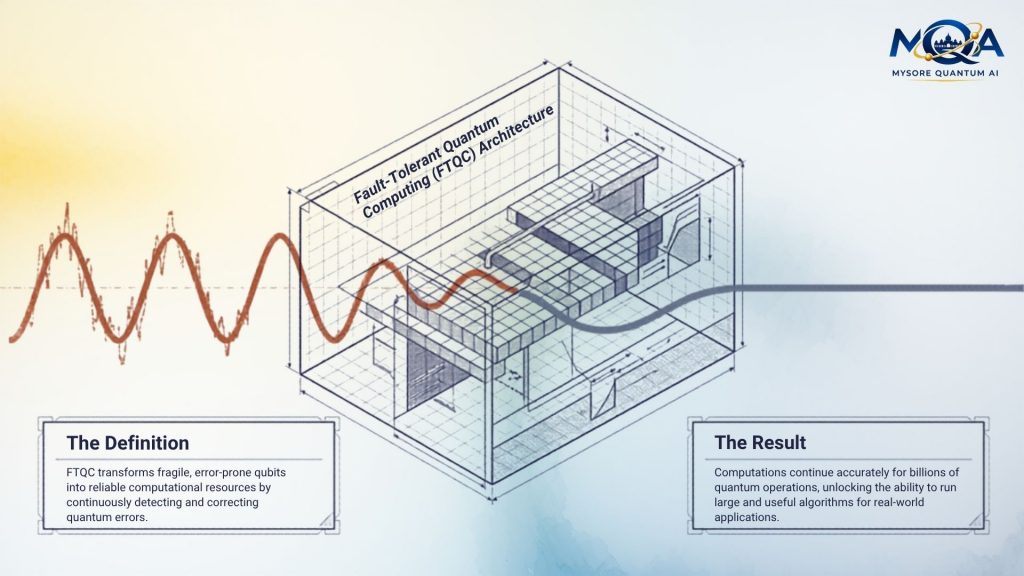
Fault-tolerant quantum computing is the ability of a quantum computer to perform very long and complex calculations reliably, even though its physical qubits are naturally noisy and prone to errors. A fault-tolerant quantum computer is one that can detect and correct errors faster than they occur, allowing computations to continue accurately for millions or even billions of quantum operations. This is considered one of the most important milestones in the history of quantum computing because it would enable quantum computers to solve practical problems that are beyond the reach of today’s machines.
The Core Problem: Quantum Errors
A classical bit can only be: 0 / 1
A qubit can be:
∣ 𝜓⟩ = 𝛼 ∣ 0⟩ + 𝛽 ∣ 1⟩
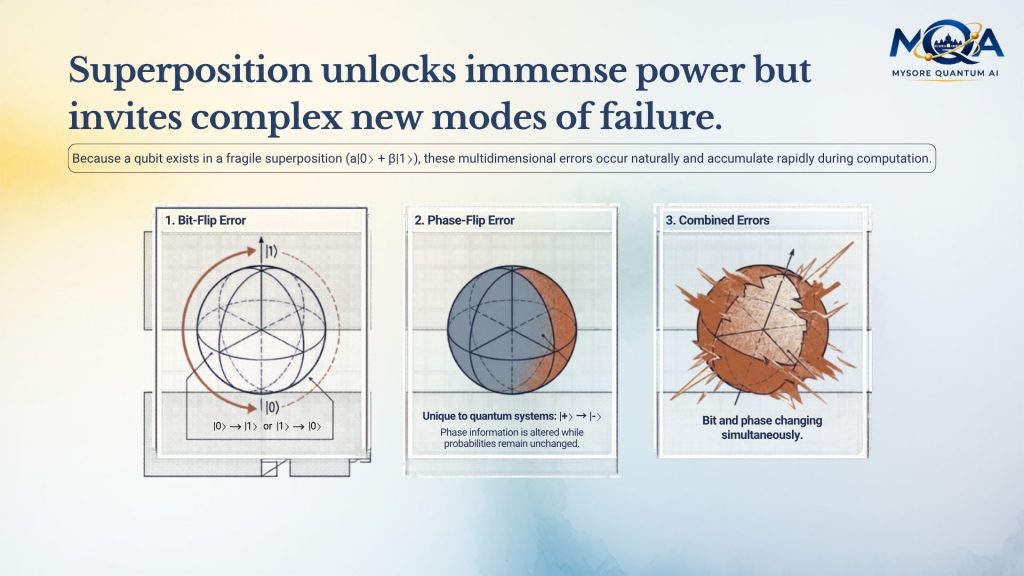
Because a qubit exists in a superposition, many more types of errors can occur.
- Bit-Flip Error
Just like a classical error:
∣ 0⟩ →∣ 1⟩
or
∣ 1⟩ →∣ 0⟩ - Phase-Flip Error
Unique to quantum systems.
∣ +⟩ →∣ −⟩
The probabilities remain unchanged, but the phase information is altered. - Combined Errors
Both bit and phase can change simultaneously. These errors accumulate rapidly during a computation.
Why Not Just Copy the Qubit?
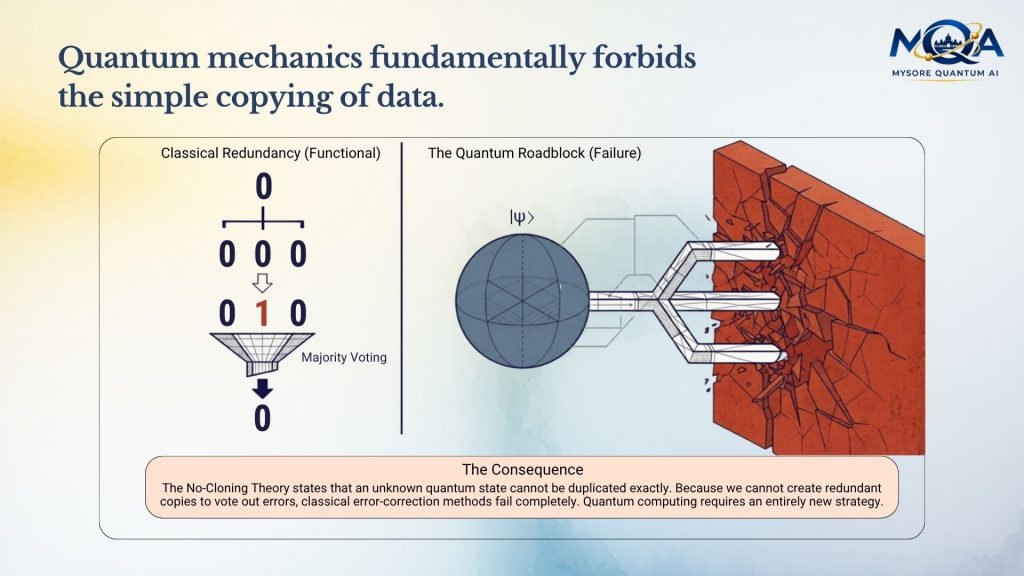
In classical computing, reliability is easy.
Store three copies of the bit:
0 0 0
If one flips:
0 1 0
Majority voting restores the correct value. Quantum mechanics does not allow this due to the No-Cloning Theorem. A quantum state cannot be copied perfectly.
No-Cloning Theorem states: An unknown quantum state cannot be duplicated exactly.
Therefore, classical error-correction methods do not work. Quantum computing requires a completely different strategy
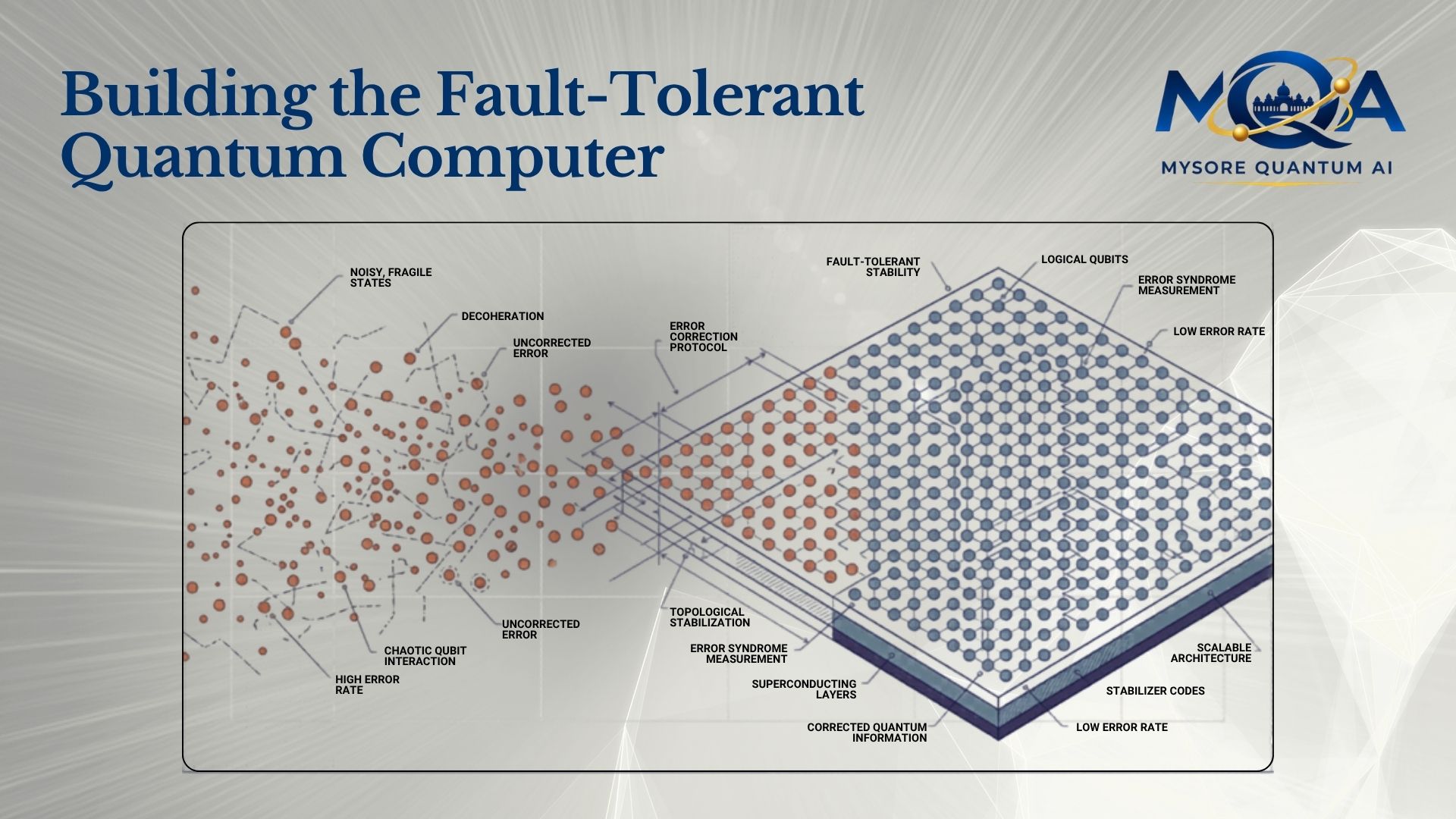
Fault-tolerant quantum computing is achieved through a brilliant, multi-layered strategy:
- Physical Qubits vs. Logical Qubits
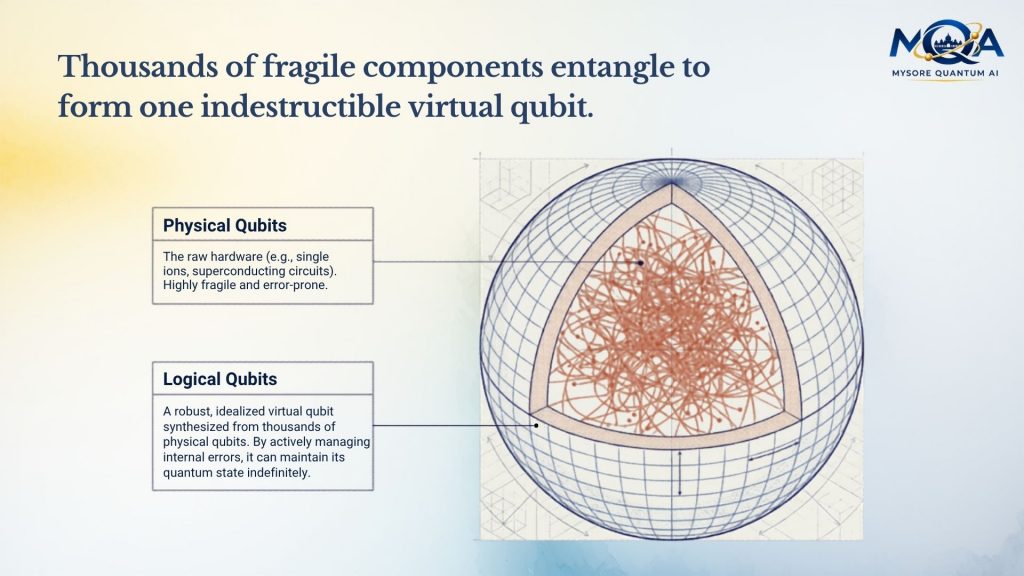
The core secret of fault tolerance is that you never run your actual algorithm on raw, physical qubits. Instead, you use Quantum Error Correction (QEC). QEC takes thousands of highly fragile physical qubits and links them together via quantum entanglement to act as a single, perfectly protected logical qubit.
- Physical Qubit: The actual hardware (e.g., a single ion, a superconducting circuit). Error-prone and fragile.
- Logical Qubit: A robust, idealized virtual qubit made up of many physica qubits. It can maintain its quantum state indefinitely because the system actively manages its errors.
- Redundancy and the Surface Code
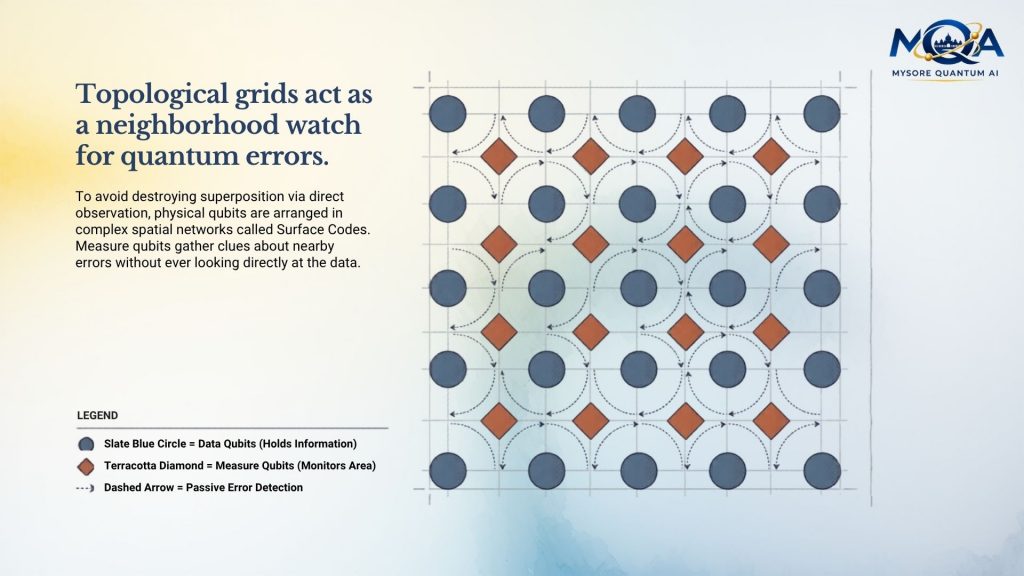
- How do you protect data without looking at it? In quantum mechanics, observing a qubit destroys its quantum superposition.
- To get around this, physicists use complex spatial arrangements called topological codes (like the Surface Code). The physical qubits are arranged in a grid. Some qubits hold the actual data, while neighboring measure qubits are used solely to look for clues about whether an error has occurred nearby without ever looking at the data
qubits directly
3. The Error Threshold
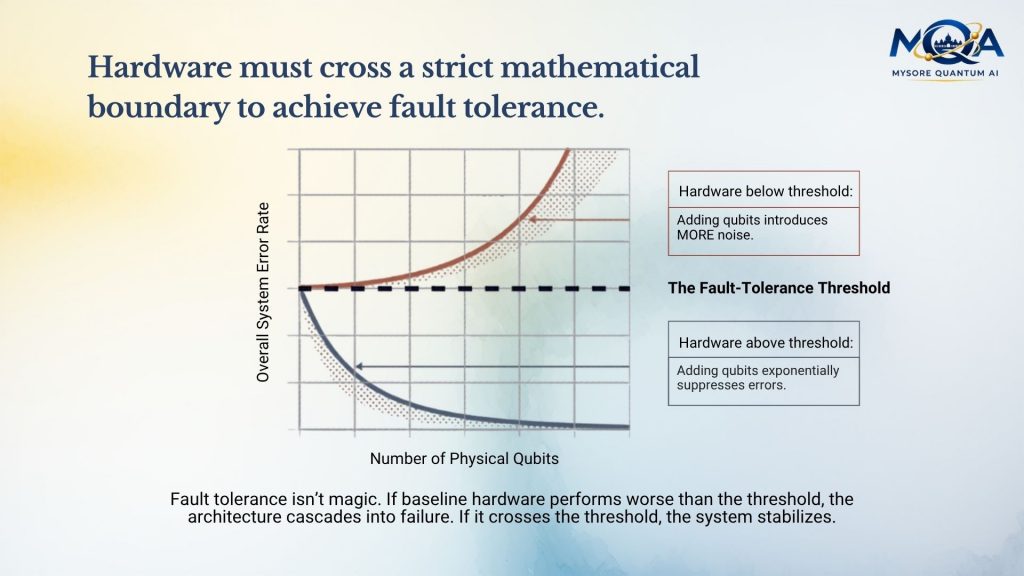
- Fault tolerance isn’t magic; it requires the hardware to meet a strict mathematical boundary called the fault-tolerance threshold.
- If the error rate of your physical qubits is higher than this threshold, adding more physical qubits actually introduces more noise than it fixes. But if your physical qubits perform better than the threshold, adding more physical qubits exponentially suppresses the overall error rate.
Why is FTQC a Game Changer?
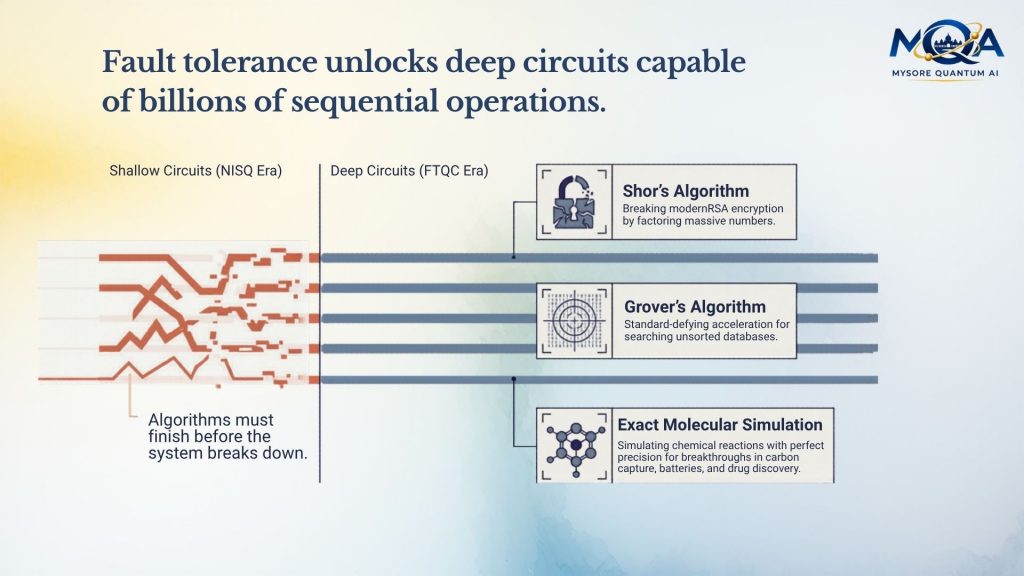
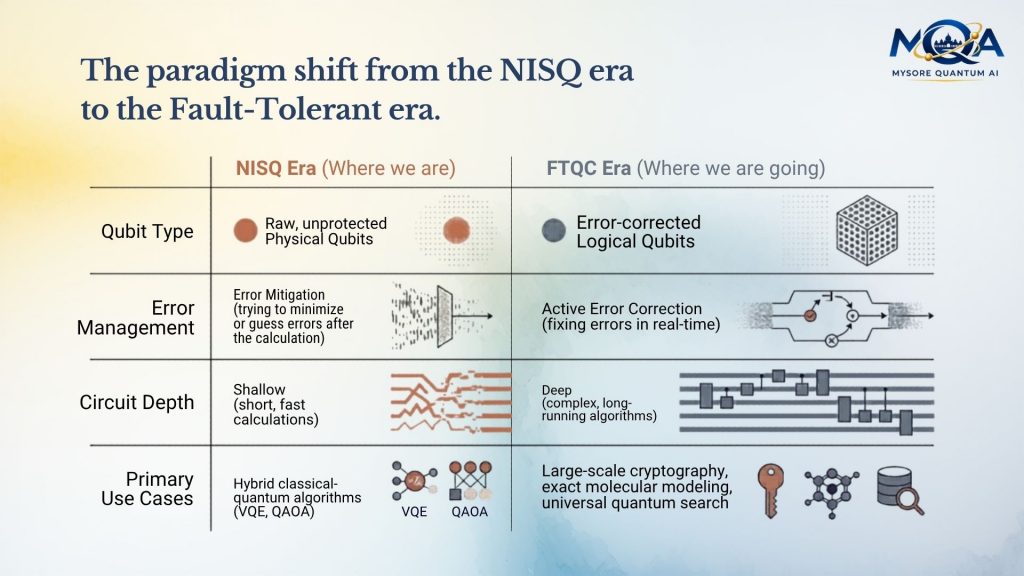
Until we reach FTQC, we are severely limited in the types of algorithms we can run. NISQ devices can only run “shallow” circuits—short algorithms that finish before the system breaks down.
With FTQC, we unlock “deep” circuits—algorithms that require billions of sequential gate operations. This is where the world-changing applications live:
- Shor’s Algorithm: Breaking modern RSA encryption by factoring massive numbers.
- Grover’s Algorithm: Standard-defying acceleration for searching unsorted databases.
- Exact Molecular Simulation: Simulating complex chemical reactions and catalysts with perfect precision, leading to breakthroughs in carbon capture, battery chemistry, and targeted drug discovery.
The Scale of the Challenge
If FTQC is so great, why haven’t we built one yet? It comes down to a staggering numbers game.
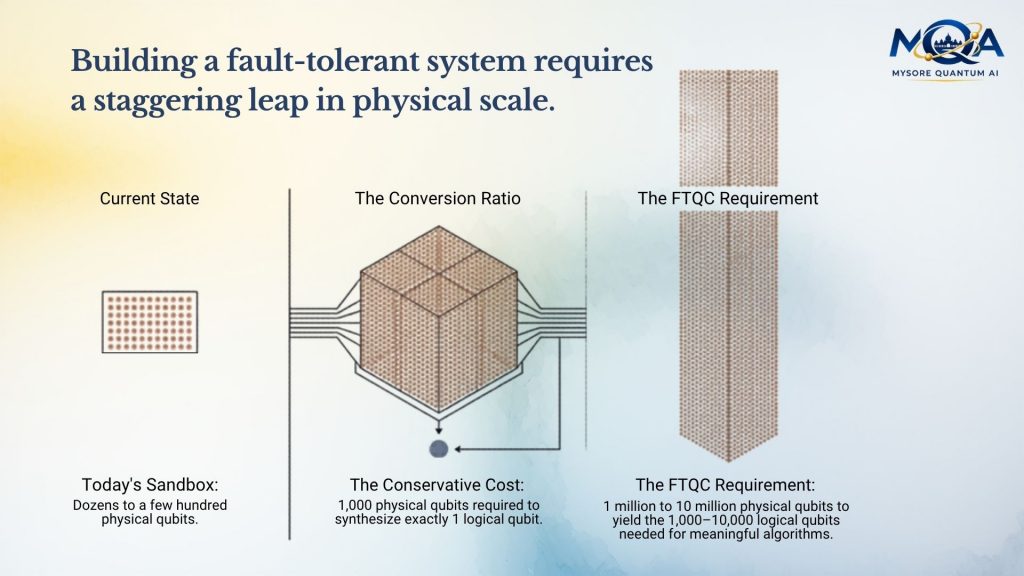
To run a meaningful fault-tolerant algorithm, you might need 1,000 to 10,000 logical qubits. If it takes a conservative ratio of 1,000 physical qubits to create just one logical qubit, a fault-tolerant quantum computer will require anywhere from 1 million
to 10 million physical qubits.
Right now, the world’s leading quantum processors are hovering in the sandbox of dozens to a few hundred physical qubits.
Summary: The Road Ahead
One-Sentence Summary
Fault-tolerant quantum computing is the technology that transforms fragile, errorprone qubits into reliable computational resources by continuously detecting and correcting quantum errors, enabling quantum computers to run large and useful algorithms for real-world applications.