Algorithms and Concepts That Matter
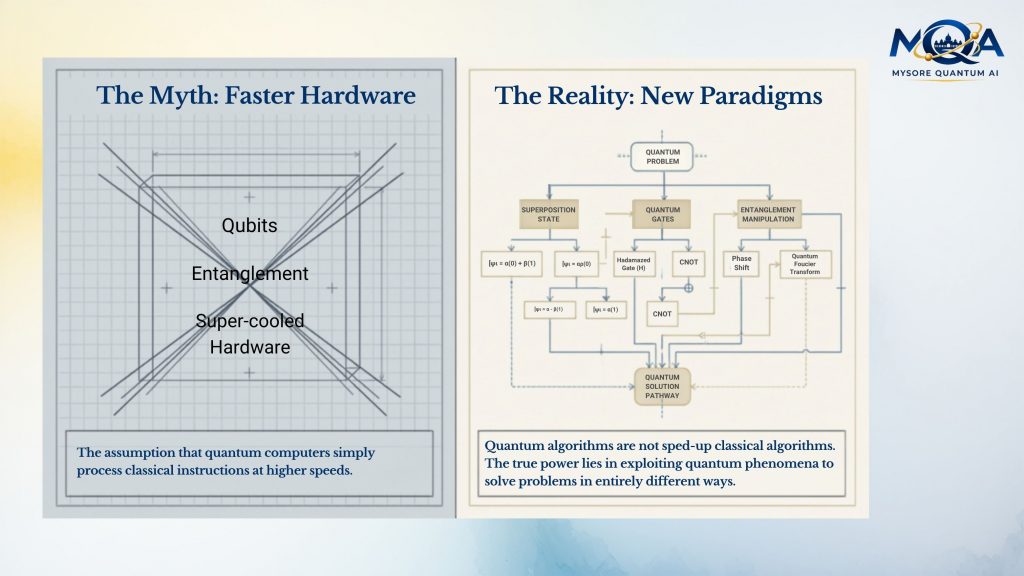
When people first learn quantum computing, they often focus on qubits, superposition, entanglement, and quantum gates. While these are essential building blocks, they are not the reason quantum computers are exciting.
The real power of quantum computing comes from the algorithms and computational concepts that exploit these quantum phenomena to solve problems differently from classical computers. Quantum algorithms are not classical algorithms that have been sped up.
This article introduces the most important algorithms and concepts that every beginner should know
The Core Structural Concepts
Before looking at specific algorithms, we must understand the core quantum “building blocks” that software engineers use to manipulate data.
1. Quantum Parallelism and Uniform Superposition
The starting line for almost every quantum algorithm is to take a register of qubits (all starting at |0⟩) and blast them with Hadamard (H) gates.
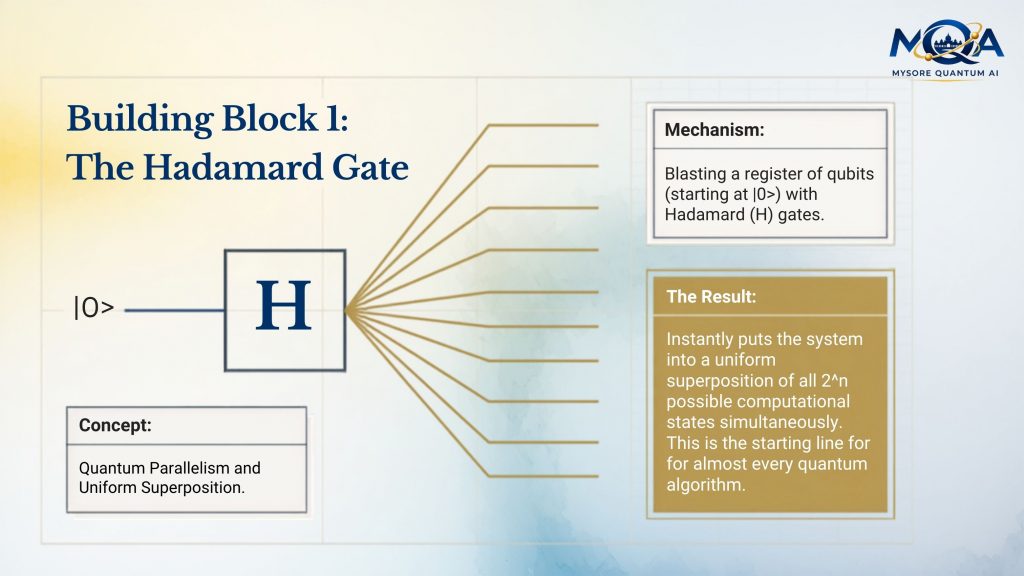
The Hadamard gate takes a definite state and splits it into an equal superposition of |0⟩ and |1⟩ . When you apply a Hadamard gate to n qubits, you instantly put the system into a uniform superposition of all 2n possible computational states simultaneously.
2. The Quantum Oracle (The Black Box)
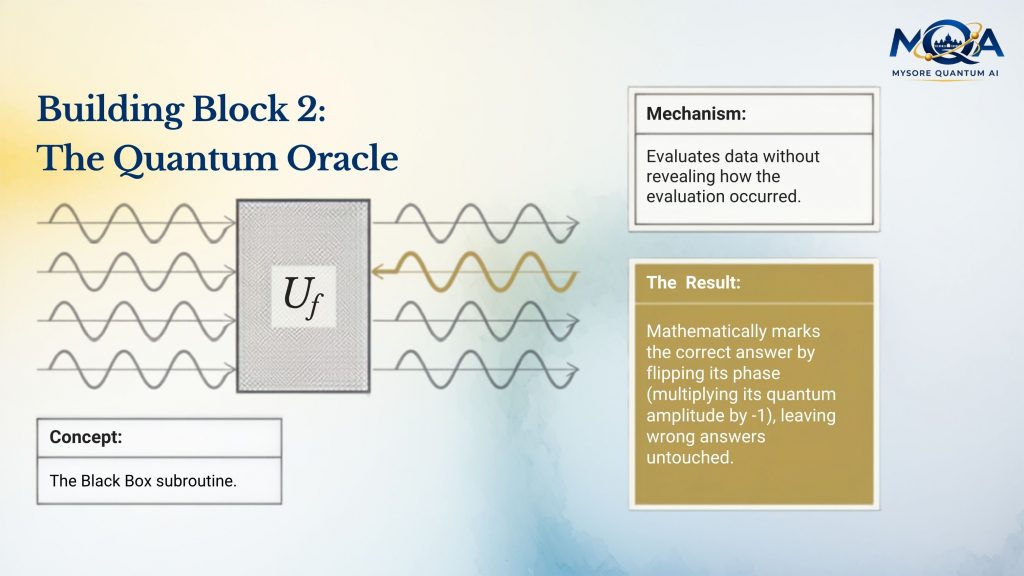
In many algorithms, you will hear the term Oracle. Think of an oracle as a black-box subroutine. It evaluates data without revealing how it evaluated it.
If you are looking for a specific item in a database, the oracle mathematically “marks” the correct answer by flipping its phase (multiplying its quantum amplitude by -1), while leaving the wrong answers untouched. The algorithm’s job is then to turn that hidden phase change into something we can actually see when we measure the qubits.
Major Algorithms Every Beginner Should Know
1. Deutsch’s Algorithm: The Simplest Quantum Speedup
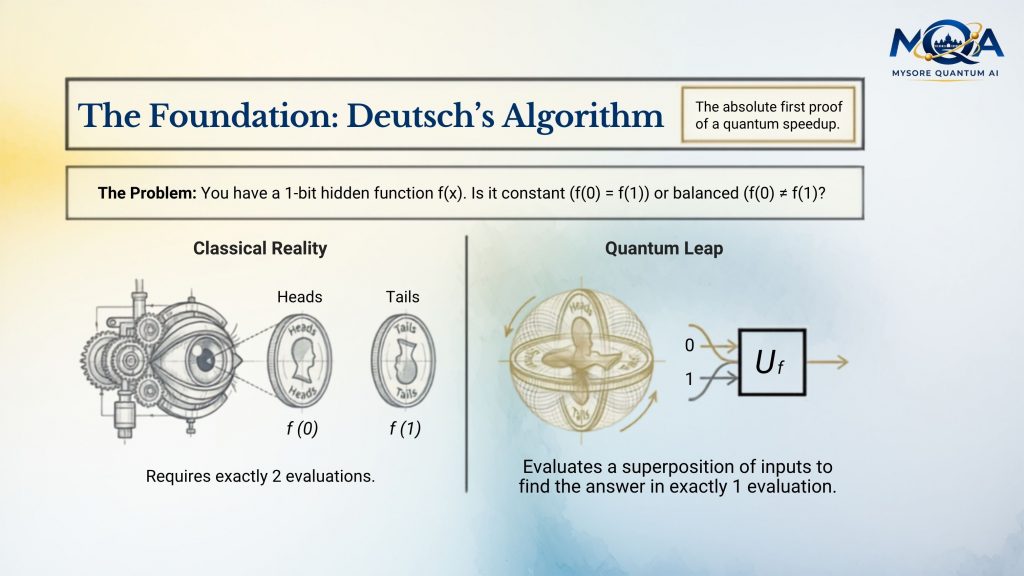
Before David Deutsch expanded the concept into the Deutsch-Jozsa algorithm, he designed a simpler version for a single qubit. This foundational algorithm was the absolute first to prove that a quantum computer could outpace a classical one by exploiting quantum superposition.
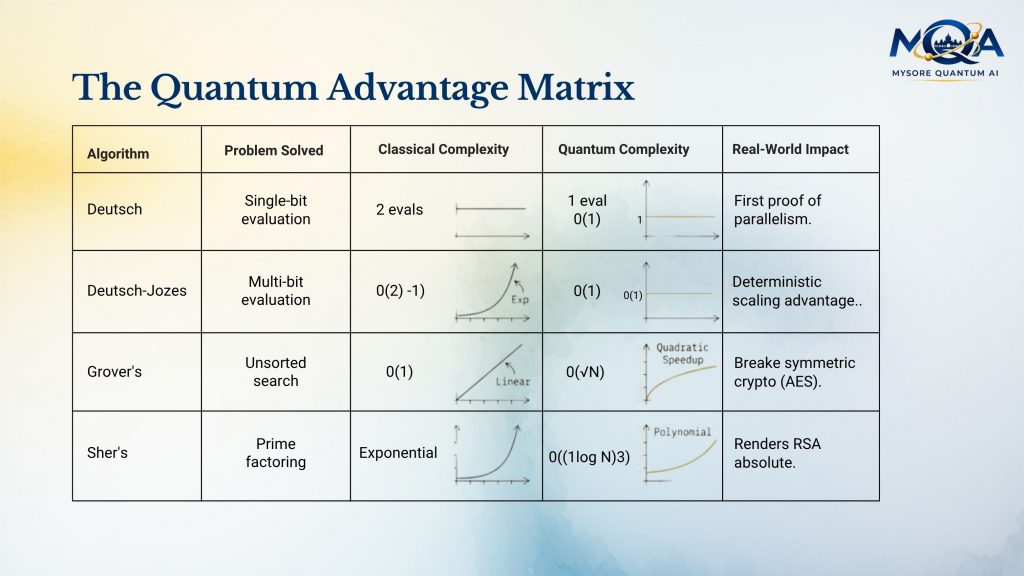
- The Problem: You have a hidden one-bit black-box function, f(x), that takes a single bit as an input (0 or 1) and outputs a single bit (0 or 1). You need to find out if the function is constant (meaning f(0) = f(1)) or balanced (meaning f(0) ≠ f(1)).
- The Classical Way: A classical computer has no choice but to evaluate the function twice. It must calculate f(0), then calculate f(1), and finally compare them.
- The Quantum Way: By evaluating the function using a superposition of inputs, a quantum computer can determine if the function is constant or balanced using exactly one single evaluation.
2. Deutsch-Jozsa Algorithm: The Proof of Concept
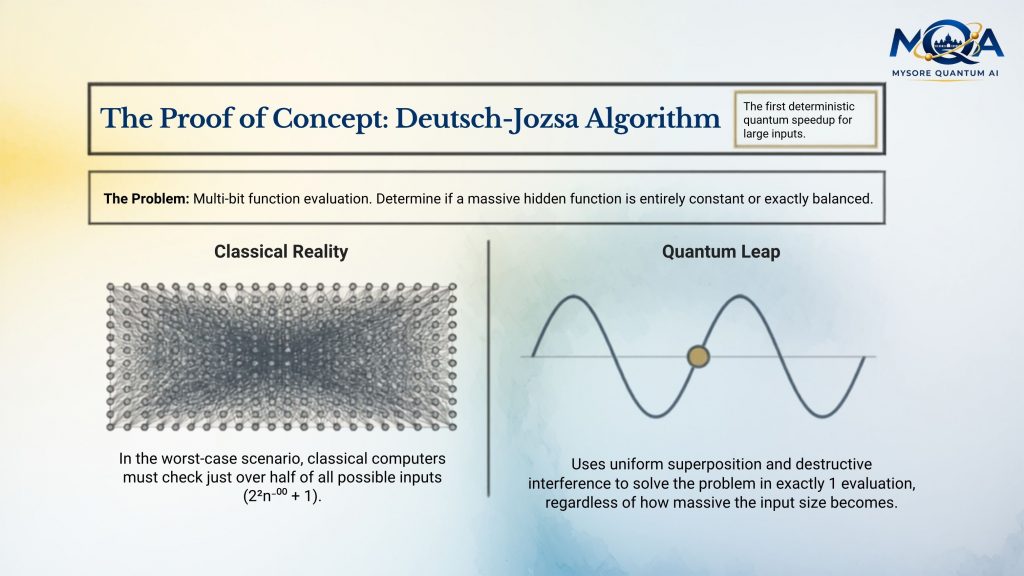
The Deutsch-Jozsa algorithm solves a highly contrived, academic problem, but it holds a massive place in history: it was the first algorithm to prove a deterministic quantum speedup over classical computing.
- The Problem: You are given a hidden black-box function. You are promised that the function is either constant (it outputs the same thing for every input) or balanced (it outputs 0 for exactly half the inputs and 1 for the other half). You need to determine which one it is.
- The Classical Way: In the worst-case scenario, a classical computer has to check just over half of all possible inputs (2n-1 + 1) to be absolutely sure.
- The Quantum Way: By using a uniform superposition and exploiting destructive interference, the Deutsch-Jozsa algorithm solves this problem in exactly one single evaluation, regardless of how massive the input size is.
3. Grover’s Algorithm: Searching the Unsorted Ocean
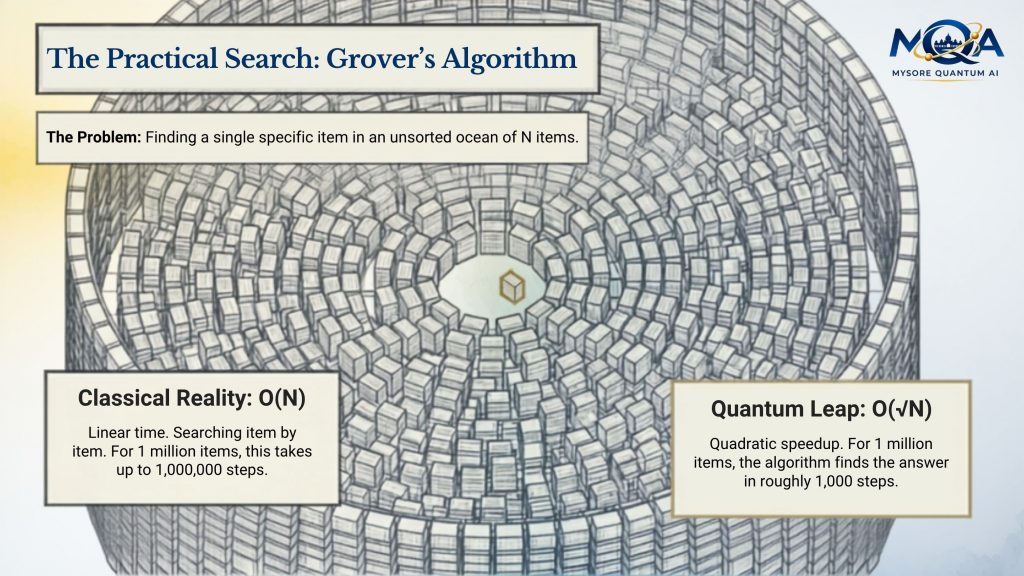
Imagine trying to find a single specific name in a phone book containing 1 million entries, but the book is sorted completely randomly.
- The Problem: Searching through an unsorted database of N items.
- The Classical Way: You have to look at each entry one by one. On average, it takes N/2 steps, and in the worst case, it takes N steps. This is a linear time complexity, or O(N).
- The Quantum Way: Grover’s algorithm achieves a quadratic speedup, solving the problem in roughly √N steps. For 1 million items, a classical computer takes up to 1,000,000 steps; Grover’s algorithm takes only about 1,000 steps.
How Grover’s Works: Amplitude Amplification
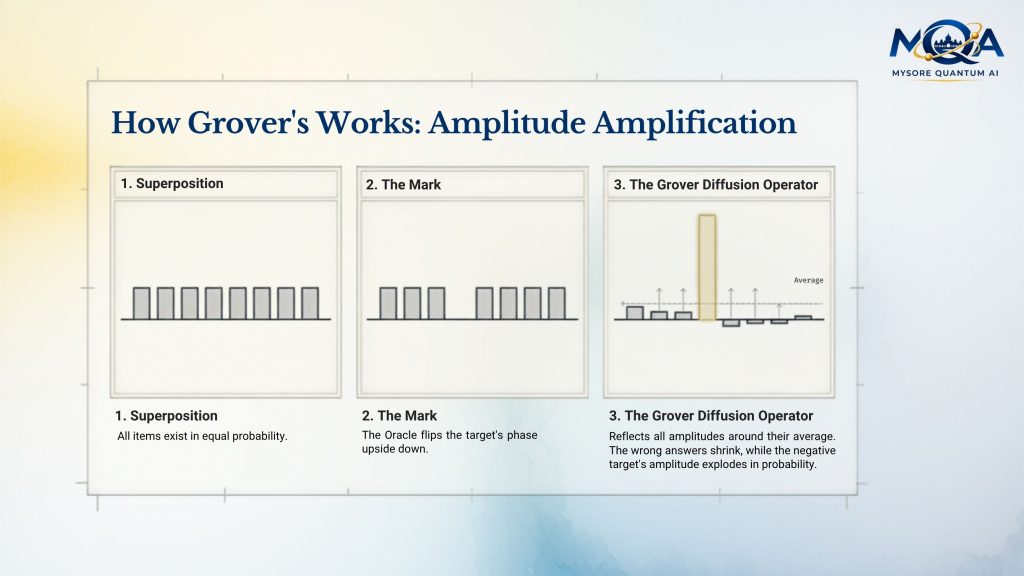
Grover’s algorithm uses a geometric technique called Amplitude Amplification.
- It begins by putting all database items into an equal superposition.
- The oracle marks the target item by flipping its phase upside down.
- The algorithm applies a Grover Diffusion Operator, which reflects all the amplitudes around their average value. Because the target item was flipped downward, this reflection causes its amplitude to shoot upward, while the wrong answers shrink.
4. This process is repeated roughly √N times until the correct answer’s probability is near 100%.
4. Shor’s Algorithm: The Cyber-Security Threat
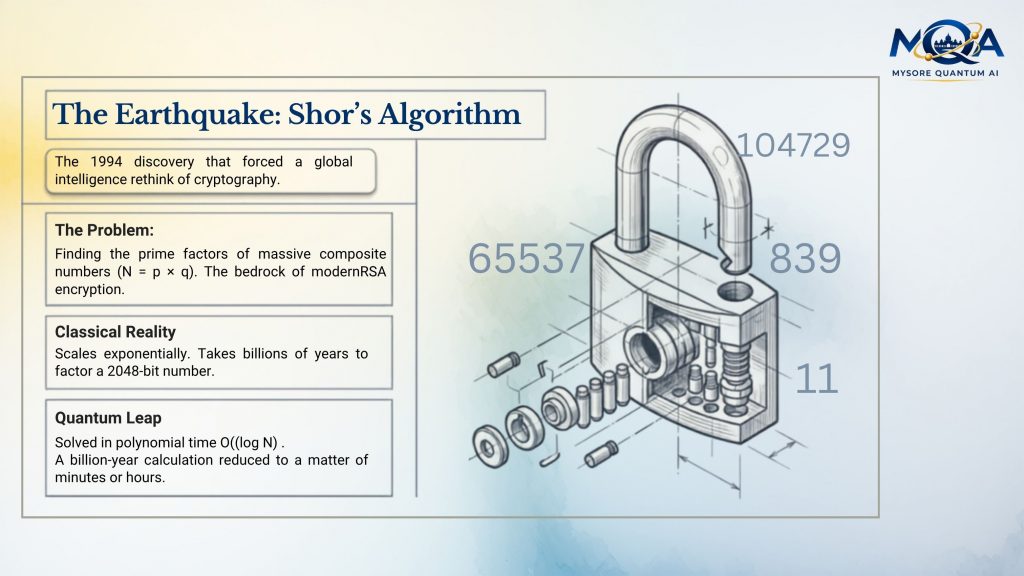
If Grover’s algorithm is a steady upgrade, Shor’s algorithm is an absolute earthquake. Its creation in 1994 single-handedly forced global intelligence agencies to start rethinking modern cryptography.
- The Problem: Finding the prime factors of a massive composite number (N = p × q). This math problem forms the bedrock of RSA encryption, which secures everything from credit card transactions to military communications.
- The Classical Way: Classical computers are notoriously terrible at factoring. The best known classical algorithm scales exponentially, taking billions of years to factor a 2048-bit number.
- The Quantum Way: Shor’s algorithm solves this in polynomial time (O((log N)3)) reducing a billion-year calculation to a matter of minutes or hours.
How Shor’s Works: Period Finding
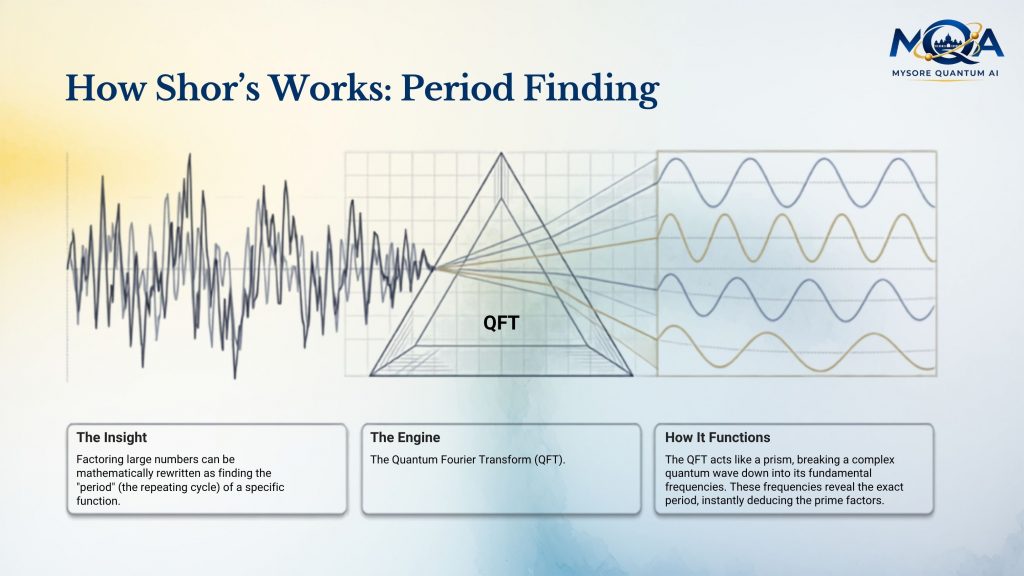
Shor cleverly realized that the problem of factoring large numbers can be rewritten as a problem of finding the period (or repeating cycle) of a specific mathematical function.
To find this clock-like repetition, Shor’s algorithm uses the Quantum Fourier Transform (QFT). The QFT acts like a prism, breaking a complex quantum wave down into its fundamental frequencies. The frequencies that emerge point directly to the period of the function, which can then be fed back into a classical computer to instantly deduce the prime factors.
The Quantum Advantage
A Useful Mental Model
Nearly every quantum algorithm follows the same high-level pattern:
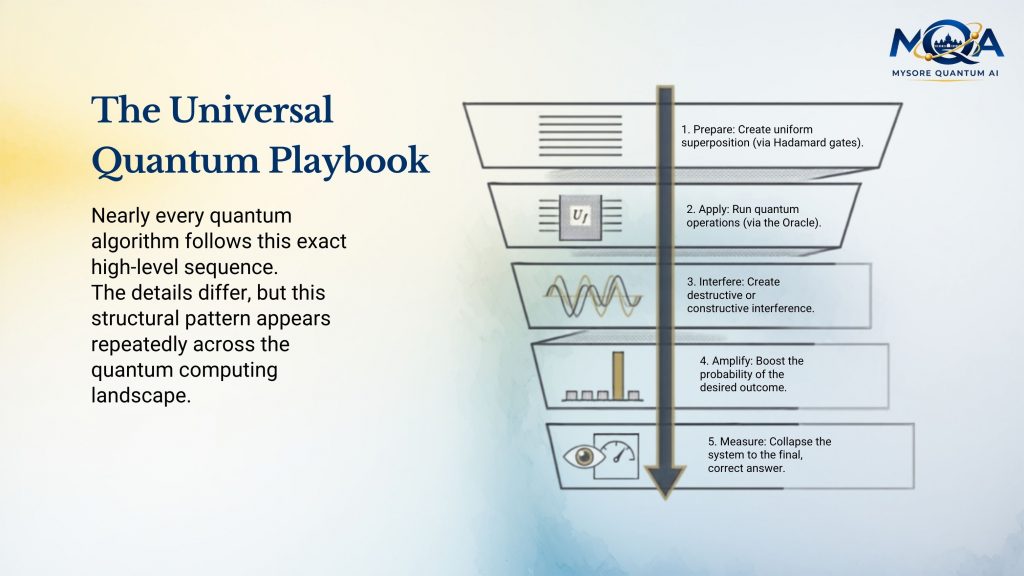
The details differ, but this structure appears repeatedly across the quantum computing landscape.